
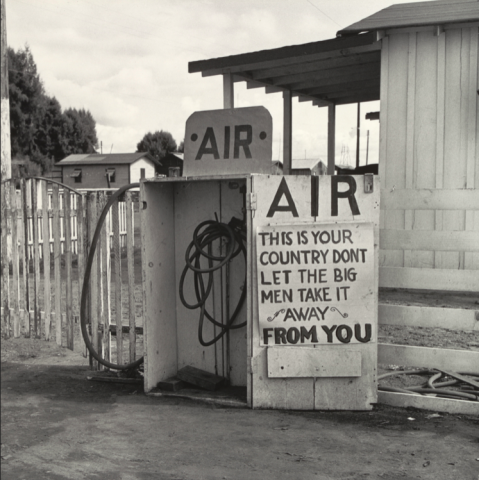
 Dorothea Lange. Kern County, California, November 1938. Gelatin silver print, printed 1965. 12 7/16 x 12 1/2" (31.6 x 31.7 cm).
DOROTHEA LANGE - Words & Pictures
Museum of Modern Art - New York ( February 9 – May 9, 2020 )
Toward the end of her life, Dorothea Lange (1895–1965) reflected, “All photographs—not only those that are so called 'documentary’...can be fortified by words.” A committed social observer, Lange paid sharp attention to the human condition, conveying stories of everyday life through her photographs and the voices they drew in. Dorothea Lange: Words & Pictures, the first major MoMA exhibition of Lange’s in 50 years, brings iconic works from the collection together with less seen photographs—from early street photography to projects on criminal justice reform. The work’s complex relationships to words show Lange’s interest in art’s power to deliver public awareness and to connect to intimate narratives in the world.
In her landmark 1939 photobook An American Exodus—a central focus of the show—Lange experiments with combining words and pictures to convey the human impact of Dust Bowl migration. Conceived in collaboration with her husband, agricultural economist Paul Taylor, the book weaves together field notes, folk song lyrics, newspaper excerpts, and observations from contemporary sociologists. These are accompanied by a chorus of first-person quotations from the sharecroppers, displaced families, and migrant workers at the center of her pictures. Presenting Lange’s work in its diverse contexts—photobooks, Depression-era government reports, newspapers, magazines, poems—along with the voices of contemporary artists, writers, and thinkers, the exhibition offers a more nuanced understanding of Lange’s vocation, and new means for considering words and pictures today.
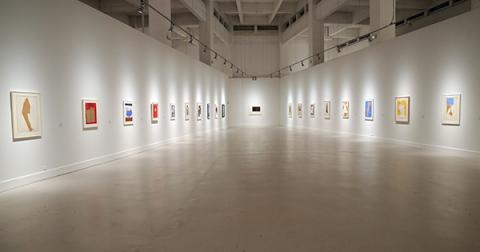 Exhibition view
Centro de Arte Contemporáneo de Málaga ( February 7 - May 17, 2020 )
The CAC Málaga is proud to present the work of Robert Mother- well (Aberdeen, Washington, 1915 – Provincetown, Massachu- setts, 1991) in Collages, the first exhibition in Spain devoted entirely to this creative technique. The show consists in almost thirty works, several of which are over one metre wide.
Motherwell was an American painter, printmaker and editor. Ini- tially influenced by Surrealist Automatism, he went on to become a prominent exponent and theorist of Abstract Expressionism. He was a member of the New York School, which included renowned artists like Jackson Pollock, Mark Rothko and Willem de Kooning. This school began a movement in which painting triumphed as a map of visual experimentation based on working with the medium itself: colour and the two dimensions of the picture plane.
The works selected for this exhibition were produced during the most mature period of his career, in the 1960s, 70s and 80s. Motherwell approached these idiosyncratic creations with opti- mism and conviction; as spaces conducive to ellipses and sudden twists, they give rise to unexpected consequences and allow for possibilities opposed to the gesturality of the brush. They require viewers to have a contemplative attitude and an open mind, to see beyond the surface and observe from a distance, without fixating on their immediate meaning or usefulness, and above all to appre- ciate their capacity for transcendence.
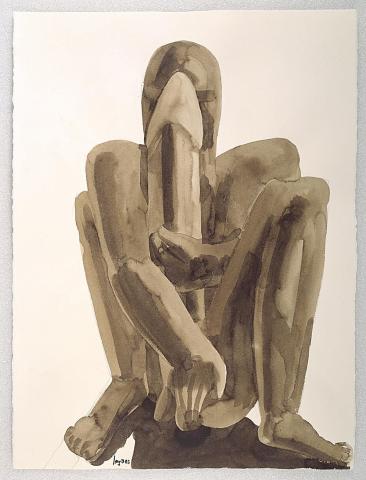 Miquel Navarro / Apoyado II, 2003. Institut Valencià d'Art Modern, Generalitat. Donación del artista. © Miquel Navarro, VEGAP, Valencia, 2020.
Case study. Miquel Navarro’s secret collection
IVAM, Institut Valencià d'Art Modern ( January 30, 2020 - May 31, 2020 )
Miquel Navarro (Mislata, 1945) was one of the group of artists who transformed sculpture in the late 1970s. His large installations in towns and cities are welcoming places but they also form part of the authority that dominates and controls. A similar effect is produced by his monumental totems, anthropomorphic machines that are also protective deities and menacing gods.However, his drawings are more immediate and are a response to what he himself has defined as “the flow of life”.
This exhibition is a secret collection, like the ones that still remain in archaeological museums, in which the drawings and small clay sculptures made by Miquel Navarro that are preserved in the IVAM can be seen alongside African fetishes and masks, archaeological objects and toys, all of which belong to his personal collection
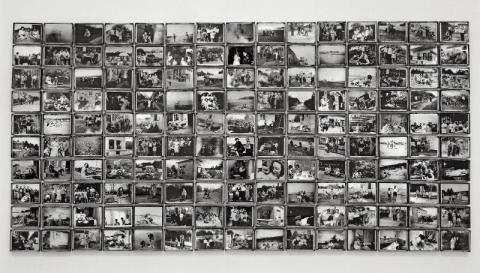 Christian Boltanski, Album de photos de la famille D., 1939-1964 (1971 @)Musée d'art moderne et contemporain de Saint-Étienne Métropole. Photo Yves Bresson
CHRISTIAN BOLTANSKI - Life in the Making
Musée National d’Art Moderne, Centre Pompidou. Paris ( Novenber 13, 2019 - March 16, 2020 )
Through a pathway of some fifty works by Christian Boltanski, this vast presentation by one of the key figures of contemporary creation reveals the magnitude and ambition of an artist marked by his history and a half-century of questioning on the role and voice of the artist in our societies.
Thirty-five years have passed since Christian Boltanski’s first exhibition at the Centre Pompidou. Designed by Boltanski himself as a vast journey into the heart of his work, this new exhibition is not so much a retrospective as a series of sequences marking the steps and transformations of his approach.
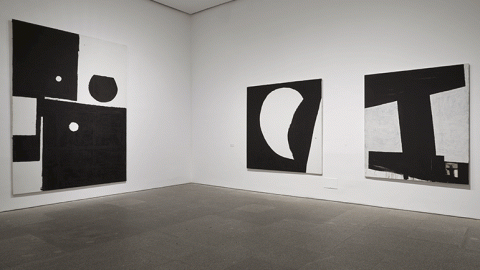 View of the exhibition Miguel Ángel Campano. D’après
MIGUEL ÁNGEL CAMPANO - D’après
Museo Nacional Centro de Arte Reina Sofía ( November 6, 2019 - April 20, 2020 )
The Museo Reina Sofía stages a retrospective survey of the work of artist Miguel Ángel Campano (Madrid, 1948 – Cercedilla, Madrid, 2018) by way of a selection in excess of one hundred works made from 1972 onwards. The show, the last exhibition project in which the artist directly took part, parades the problems, processes, and resources Campano focused on. Not ever channeling them into the ditch of any single style, Campano’s long cycles of painting succeeded; and so narrating Campano’s oeuvre – and its many forms – always requires enunciating an “and then,” an après. Sticking to Campano’s succeeding interests, the exhibition also renders an account of the constants in a career traversed by emotional impetus and an analytical, learned approach to painting.
Campano’s work was also referential: when observing and painting the art of the past, he often painted d’après Eugène Delacroix or Nicolas Poussin, becoming heir to the languages that the history of art had made available. Yet Campano’s canvases d’après are never merely works “according to” the painter he was studying, but rather “following from,” and hence releasing a flight from the canon. His works from life – d’après nature – depart from their own objective referents, too. All in all, as concerns the d’après which feeds Campano’s work, to predicate an “according to” is only possible for Campano's painting proper. The exhibition thus can be summed up as a digest of painting according to the artist, a museum of paintings d’après Campano.
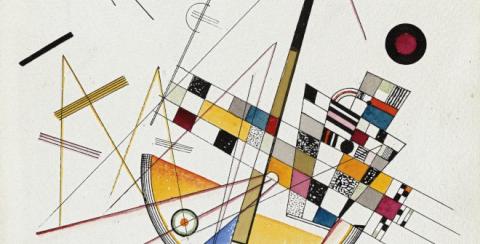 Wassily Kandinsky. Delicate Tension No. 85, 1923. Watercolour and ink on paper. 35.5 x 25 cm © Wassily Kandinksy, VEGAP, Madrid
The Bauhaus in the Thyssen collections
Museo Nacional Thyssen-Bornemisza - Madrid ( October 28, 2019 - January 12, 2020 )
To mark the centenary of the Bauhaus, the Thyssen Bornemisza Museum is organising a small exhibition featuring works by artists historically associated with the school and part of the museum’s permanent collection.
Located on the museum’s first floor balcony, the exhibition pay particular attention to works created in the period when the Bauhaus was active (1919-1933) and, some of which have been on display in exhibitions organised by the school. Therefore, the project, curated by the museum’s curatorial team, includes the publication of a short explanatory catalogue.
The Staatliche Bauhaus, which means State Construction House, was the school of architecture, design, crafts and art founded by Walter Gropius in 1919 in the city of Weimar (Germany). Better known as simply Bauhaus, it was closed by the Nazi Party in 1933, leading to many of its members moving to the United States.
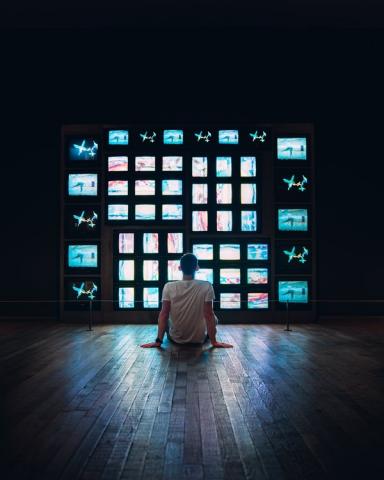 Nam June Paik TV Eyeglasses 1971 Collection & © The Estate of Nam June Paik. Photography © Liam Man
Tate Modern - London ( October 17, 2019 – February 9, 2020 )
Nam June Paik’s experimental, innovative, yet playful work has had a profound influence on today’s art and culture. He pioneered the use of TV and video in art and coined the phrase ‘electronic superhighway’ to predict the future of communication in the internet age.
This major exhibition is a mesmerising riot of sights and sounds. It brings together over 200 works from throughout his five-decade career – from robots made from old TV screens, to his innovative video works and all-encompassing room-sized installations such as the dazzling Sistine Chapel 1993.
Born in South Korea in 1932, but living and working in Japan, Germany and the US, Paik developed a collaborative artistic practice that crossed borders and disciplines. The exhibition looks at his close collaboration with cellist Charlotte Moorman. It also highlights partnerships with other avant-garde artists, musicians, choreographers and poets, including John Cage, Merce Cunningham and Joseph Beuys.
Exhibition organised by Tate Modern and San Francisco Museum of Modern Art in collaboration with Stedelijk Museum Amsterdam, the Museum of Contemporary Art, Chicago and National Gallery of Singapore
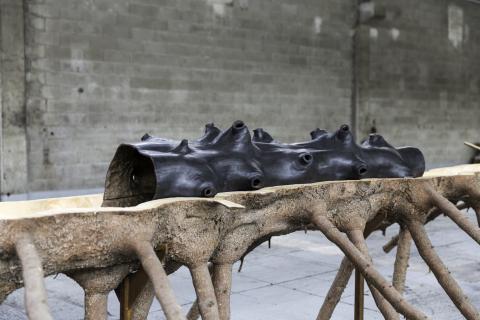 Giuseppe Penone, Matrice, 2015 Spruce wood, bronze 110 x 250 x 3000 cm foto © Archivio Penone
GIUSEPPE PENONE . Incidences of the Void
Castello di Rivoli Museum of Contemporary Art - Torino ( October 12, 2019 – February 2, 2020 )
Giuseppe Penone. Incidences of the void stems from the collaboration between the CRC Foundation and the Castello di Rivoli Museum of Contemporary Art. Conceived as an exhibition project shared between the two institutions in the Monumental Complex of San Francesco in Cuneo and in the garden of the Castello di Rivoli, the exhibition presents the heart of the research of the artist Giuseppe Penone (Garessio, 1947). A reflection on the duality between empty and full as constitutive and material parts of his artistic work, through a precise selection of works that connect the two locations, in a sophisticated game of juxtapositions and references. Today, among the most important and recognized sculptors in the world, the artist emerged in the late sixties in the context of Arte Povera.
Among the most important and innovative artistic movements of the 20th century on an international level, Arte Povera has its origin in Piedmont, from which an important core of the group of artists comes. Arte Povera is generally defined as an art of heterogeneous and "poor" materials and techniques. More important than this aspect, artists are interested in creating real situations of energy, in which nature and culture are not opposites. Today Arte Povera, and in particular the work of Penone, enjoys a renewed interest, also linked to the appreciation of that artistic freedom and the interest in nature present in it.
Penone's art explores the foundations of sculpture as a way of knowing and empirically understanding the world. His art is based on the principle of embodying a physical, tactile-visual awareness of all organisms and their transformations. Penone perceives the world and life in a sculptural way, touching and caressing its constituent parts. Even the act of breathing is a form of automatic sculpture, produced without realizing it. The sculpture concerns the carving, the excavation and the production of voids or, on the contrary, it concerns the fusion, duplication and multiplication, through a series of steps, from positive to negative, of the form being duplicated or copied. Both addition and subtraction occur through meeting gestures and, therefore, through intentional relationships between the human and matter, between the human and the non-human.
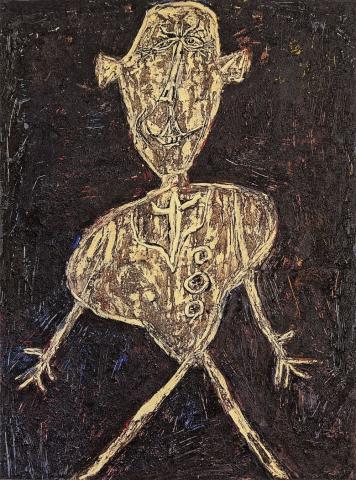 Jean Dubuffet / Henri Michaux acteur japonais, 1946. Óleo sobre lienzo 130 x 97cm Collection Financière Saint James, París / Cortesía Applicat-Prazan © Jean Dubuffet, VEGAP, Valencia, 2019
JEAN DUBUFFET - A barbarian in Europe
IVAM, Institut Valencià d'Art Modern ( October 8, 2019 - February 16, 2020 )
The show, curated by Baptiste Brun, comprises a meticulous selection of about two hundred works, including paintings, drawings, sculptures and engravings, together with many documents and objects, with which we are able to offer the public an approach to the work of Jean Dubuffet (Le Havre, 1901–Paris, 1985) from a new perspective based on history, culture and anthropology. The project is developed in ten different sections that revolve around three fundamental themes: “Celebration of the Common Man”, “Ethnography in Actuality” and “Criticism of Culture”. The exhibition has been conceived and created by the MuCEM in coproduction with the IVAM and MEG. This project is supported by the Fondation Dubuffet in Paris and the Collection de l’Art Brut in Lausanne, and also by many European institutions and private collections.
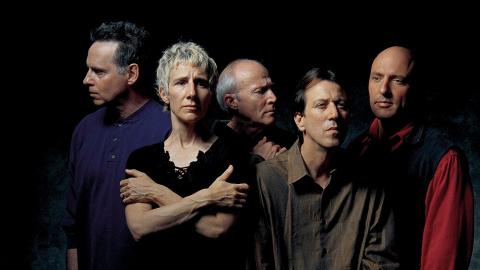 @ Bill Viola
BILL VIOLA - Mirrors of the invisible
La Pedrera - Casa Milà - Barcelona ( October 4, 2019 - January 5, 2020 )
Bill Viola (New York, 1951) is one of the most prominent and prestigious artists on the international scene. Considered one of the pioneers of video art, he masterfully uses sophisticated audiovisual technologies to explore and express a constant concern for the nature of the human being and the transience of life.
Focused on universal issues such as birth, death, pain, redemption or the passage of time, his works open the way to the senses to convey feelings and generate moods. In his creations without words the image is felt, heard, removed and reveals deep emotions. The slowed and looped movement immerses the viewer into an inner world, deepening the fundamental experiences of existence to "awaken the soul." His works, of extraordinary intensity and beauty, are unique and always move us.
The exhibition «Bill Viola. Mirrors of the invisible »offers a broad journey through the artist's career, which has evolved in parallel to the development of video technology over the past forty years, and encompasses from significant works of its beginnings, such as The Reflecting Pool (1977 -1979), until recent creations such as Martyrs (Earth, Air, Fire, Water), a commission made by the Saint Paul Cathedral in London, where it has been permanently exhibited since 2014.
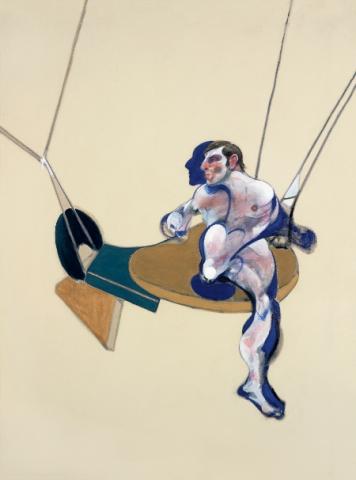 Francis Bacon, « Triptych » (détail), 1970 © The Estate of Francis Bacon/All rights reserved/Adagp, Paris and DACS, London 2019. Photo - DACS/Artimage 2019/Hugo Maertens.webloc
Centre Georges Pompidou - Paris ( Sptember 11, 2019 - January 20, 2020 )
The exhibition focuses on works produced by Bacon in the last two decades of his career (from 1971 to 1992).
It consists of sixty paintings, including 12 triptychs, in addition to a series of portraits and self-portraits, from major private and public collections.
There are six rooms along the visitor route, placing literature at the heart of the exhibition. While denying any ‘narrative’ exegesis in his work, Francis Bacon, nevertheless admitted that literature represented a powerful stimulus for his imagination. rather than giving shape to a story, poetry, novels and philosophy inspired a ‘general atmosphere’; ‘images’ which emerged like the Furies in his paintings.
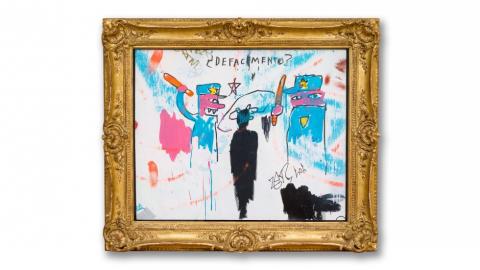 Jean-Michel Basquiat, Defacement (The Death of Michael Stewart), 1983. Acrylic and marker on wood, framed, 63.5 x 77.5 cm. Collection of Nina Clemente, New York. Photo: Allison Chipak © Estate of Jean-Michel Basquiat. Licensed by Artestar, New York
BASQUIAT´S “Defacement”: The Untold Story
Solomon R. Guggenheim Museum New York ( June 21–November 6, 2019)
A tightly focused, thematic exhibition of work by Jean-Michel Basquiat (American, 1960–1988), supplemented with work by others of his generation, will explore a formative chapter in the artist’s career through the lens of his identity and the role of cultural activism in New York City during the early 1980s. The exhibition takes as its starting point the painting Defacement (The Death of Michael Stewart) (1983), which Basquiat created to commemorate the fate of the young, black artist Michael Stewart at the hands of New York City’s transit police after allegedly tagging a wall in an East Village subway station. Originally painted on the wall of Keith Haring’s studio, Defacement was not meant to be seen publicly or enter the art market.
With approximately twenty paintings and works on paper created in the years surrounding Stewart’s death, this presentation will examine Basquiat’s exploration of black identity, his protest against police brutality, and his attempts to craft a singular, aesthetic language of empowerment. Additional paintings by Basquiat will further illustrate his engagement with police misconduct, while others will demonstrate his adaptation of crowns as symbols for the canonization of historical black figures. Also featured will be ephemera related to Stewart’s death, including newspaper clippings and protest posters, along with samples of artwork from Stewart’s estate. Paintings and prints made by other artists in response to Stewart’s death and the subsequent trial will also be included: Haring’s Michael Stewart—U.S.A. for Africa (1985); Andy Warhol’s screenprinted “headline” paintings from 1983 incorporating a New York Daily News article on Stewart’s death; and David Hammons’ series of stenciled prints entitled The Man Nobody Killed from 1986 are testaments to the solidarity experienced among artists at the time. An illustrated publication will showcase entirely new scholarship on Basquiat and the burgeoning East Village art scene during the early 1980s, an era marked by the rise of the art market, the AIDS crisis and the political activism it engendered, and the ongoing racial tensions in the city.
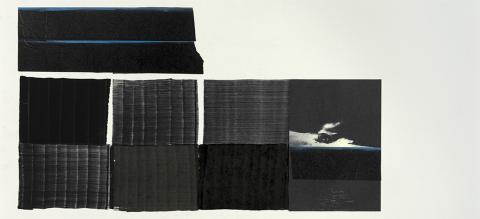 Juan Uslé I Carbón y Maculares I 2011 - 2018 I Cardboard and mixed media I 56 x 71.2 cm. I Photo: Sergio Belinchón
Museu d'Art Contemporani d'Eivissa ( June 7 - October 31, 2019)
La Sala de Armas of the Contemporary Art Museum of Ibiza (MACE) hosts the exhibition 'Notes on SQR', a compilation of 34 works by Juan Uslé (Santander, 1954) between 2011 and 2018, which is the first time to see in Ibiza pieces by one of the Spanish artists with the most international projection in contemporary art. Uslé lives and works between Spain and New York since 1987 and is considered a generational reference with a work spanning more than four decades. His paintings are included in what is called lyrical abstraction, after minimalism. It surpasses the limits of illusionism and the metaphorical one to make a synthetic and substantial representation of reality. Through memory and photography, which he uses as a record of his experiences, the artist proposes an evocation of his life making a deconstruction of any figurative reference and giving all importance to the pictorial and chromatic aspect.
The first works with the generic title of SQR ('Soñé que revelabas') emerged in 2003. The 34 drawings that are exposed to the MACE are considered autonomous works but also tests for later large format paintings. Uslé has organized these works in groups called 'Carbón y Maculaste', 'Sintaxis', 'Trama', 'Tapas / Freus', 'Islas', 'Salinas' and 'Luz' and are made in acrylic paint and, sometimes, adhesive tape and papers on cardboard. Among the last exhibitions of the creator, 'Darki Light' in the Kuntsmuseum of Bonn or '‘Luz Oscura' in the Galician Center of Contemporary Art of Santiago de Compostela, both in 2014. He participated in 1992 in Documenta 9 of Kassel and in 2005 at the Venice Biennial, in addition to receiving the 2002 National Prize for the Plastic Arts, which consolidates him as one of the most important artists today.
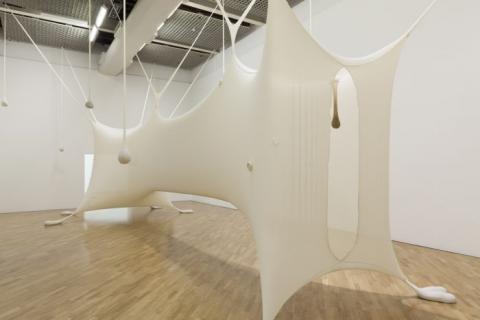 Ernesto Neto, Sopro (2019). Installation view. Photo by Isabella Matheus. Image courtesy of Pinacoteca de São Paulo
The Pinacoteca of São Paulo ( March 30 - July 15 2019 )
The Pinacoteca of São Paulo, a museum of the São Paulo State Secretariat of Culture and Creative Economy, and Banco Bradesco presents the exhibition Ernesto Neto: Sopro [Blow], which will occupy the Octagon, seven rooms on the first floor and other spaces of the Pina Luz building. Curated by Jochen Volz and Valéria Piccoli, respectively director and chief-curator of the museum, the retrospective brings together 60 works by one of the most prominent names in contemporary sculpture. Since the beginning of his career, in the 1980s, the artist has been producing a body of work that sets in motion a dialogue between the exhibition space and the various dimensions of the spectator.
Bringing into play his unique comprehension of Neo-Concrete heritage, Ernesto Neto (Rio de Janeiro, 1964) unfolds his initial sculptures – elaborated from materials such as polyamide stockings, polystyrene spheres, spices and herbs – into large, immersive installations that proposes to the spectator a space for conviviality, for taking a breath and for fostering consciousness and awareness. His sculptural practice is engendered by the tension embodied in textile materials and in handicraft techniques like crochet. These great ludic structures accommodate rituals and actions that reveal the artist’s current concerns: the affirmation of the body as an element that cannot be dissociated from the mind and from spirituality.
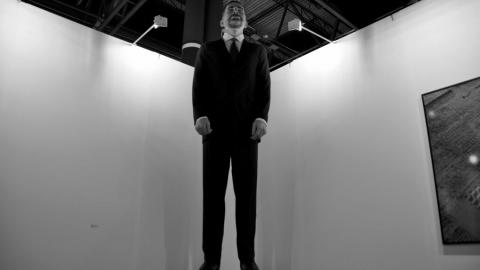 Ninot, 2019, 120 x 120 x 444 cm @ Santiago Sierra and Eugenio Merino
Ifema . Feria de Madrid ( February, 27 - March, 3 )
A total of 203 galleries from 31 countries participate, of which 166 are part of the General Program, adding to them the curated sections: 'Perú en ARCO', with a selection of 24 artists from 15 galleries; 'Diálogos', with 13 galleries and 'Opening', with 21.
From February 27 to March 3, a new edition of ARCOmadrid arrives in Madrid that turns the Spanish capital into a valued attraction for collectors, galleries, artists and art professionals from all over the world. The fair, in its 38th edition, continues in its line of adjusting its spaces and presentations to the needs of the galleries and interests of the curators. At the disposal of Peruvian artists participating in the program `Peru in ARCO`, the galleries' commitment to the presentation of one or two artists is added, as well as the growing contribution of special projects distributed by the fair, which highlight the complicity and close collaboration of the galleries with the artists.
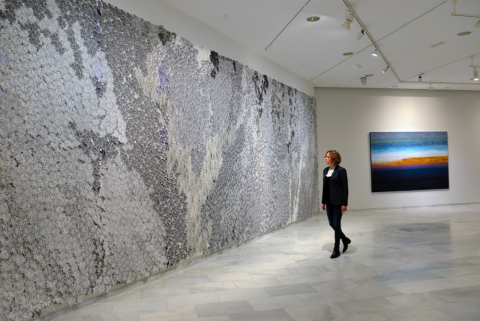 Soledad Sevilla, @ Fundación Bancaja
SOLEDAD SEVILLA -The feeling of color
Centro Cultural Bancaja - Valencia ( February, 21 - June, 30, 2019 )
Bancaja Foundation presents the exhibition Soledad Sevilla. The feeling of color, the first retrospective of the artist in Valencia, her hometown. The show, takes a tour through its more than forty years of work through a selection of 49 works dated between 1975 and 2018 that come from both the own collection of the creator and other institutional and private collectors.
Curated by María de Corral and Lorena Martínez de Corral, the exhibition reflects the artistic evolution of Soledad Sevilla and her work of representing light and space throughout her career. The exhibition is structured in blocks of different stages and creative series: the beginning in the 70s with a geometric work as a reaction to the academicism of the school of Fine Arts and diagonal lines that escape the fabric and leave room for imagination and to thought; the introduction of color at the end of the 70s and the Las Meninas series, which begins after a Harvard course on the painter and in which he does a study not only about painting, but especially about the representation of space; the series La Alhambra and Los Toros, in which light, water and forms manifest a full moment of use of frames, grids and modules as a way to transform the motives that inspire them and the sensations and feelings into lights and forms; the Insomnios series, in which nature and matter work both outside and inside and show chromatic tensions and darkness; the series Los Apóstoles, in which figuration gives way to abstraction and the artist relates wood and fabrics to talk about her love and knowledge of the history of art; and, finally, the series Nuevas lejanías y Luces de invierno, which reflect fantasies and dreams through a metamorphosis in light and color.
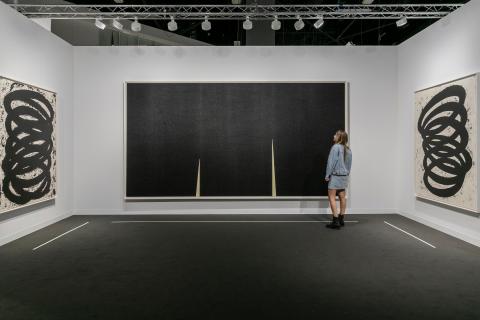 © Art Basel (Courtesy Art Basel)
Miami Beach Convention Center ( USA ) ( December 5 – 8, 2018 )
This year, over 200 of the world's leading international Modern and contemporary art galleries display artworks by over 4,000 artists, including paintings, sculptures, installations, photography, film, video, and digital art. Visitors can find works ranging from editioned pieces by young artists to museum-caliber masterpieces.
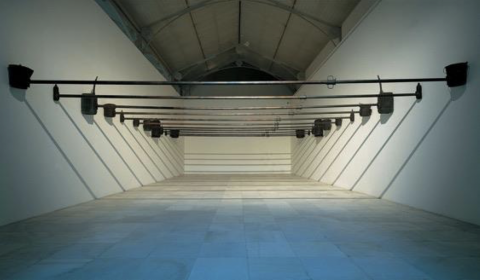 © Jaume Plensa -"Memoires Jumelles", 1992
MACBA ( Museu d’Art Contemporani de Barcelona ) ( December 1, 2018 - April 22, 2019 )
Jaume Plensa (Barcelona, 1955) is an artist of materials, sensations and ideas. His references include literature, especially poetry, music, religion and thought. He considers himself, above all, a sculptor, although his creative process has included multiple disciplines. His work addresses the very condition of being: its physical and spiritual essence, ontological awareness of present and past, moral codes and dogmas, and our relationship with nature. What we cannot explain is, precisely, what makes us human. Plensa’s objective is not to create objects, but to develop relationships that embrace everyone.
The MACBA exhibition features works from the 1980s to the present, in a journey showing the dialogue that takes place between works that represent the human figure and those that are abstract. This tension is the thread that runs through the whole of his work, a corpus that highlights the strength of binomials such as weightlessness/compactness, light/dark, silence/sound, spirit/matter and life/death.
This solo exhibition of Jaume Plensa at MACBA offers a broad overview of the work of one of the Catalan sculptors with the widest international profile. Awarded the National Visual Arts Prize of the Generalitat (1997), the Velazquez Prize for Visual Arts of the Ministry of Education and Culture (2013) and the City of Barcelona Prize (2015), among others, he is recognised worldwide for his public works in cities such as Chicago, London, Montreal, Nice, Tokyo, Toronto and Vancouver.
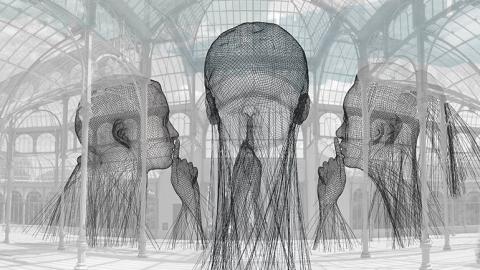 Jaume Plensa, Invisibles, 2018. © Jaume Plensa, VEGAP, Madrid, 2018
Palacio de Cristal ( Madrid ) ( November 16, 2018 - March 3, 2019 )
From his beginnings as a sculptor, Jaume Plensa (Barcelona, 1955) resorts to spirituality, the body and collective memory as fundamental sources to lock his artistic expression. Literature, psychology, biology, language and history become strategic tools in the creation of his works. With a wide spectrum of materials (steel, cast iron, resin, glass, water or sound), Plensa provides weight and physical volume to the components of the human condition and the ephemeral.
The invisible is the essence of his intervention in the Palacio de Cristal: a sculptural group made up of steel meshes that draw in the space the unfinished faces of figures suspended in the air, crossed by light and stopped in time.
Versatile artist, Jaume Plensa has experimented with engraving, drawing, sound, video and even stage design. He is one of the Spanish creators of greater international projection. He has lived and worked in Germany, Great Britain, France and the United States.
After his first solo exhibition in 1980, at the Fundació Joan Miró in Barcelona, his work has been shown in museums around the world, including the Galerie nationale du Jeu de Paume in Paris, France; the Lehmbruck Museum in Duisburg, Germany; the Nasher Sculpture Center in Dallas, USA; the Espoo Museum of Modern Art in Helsinki, Finland; the Toledo Museum of Art, Toledo, USA; the Musée d'Art Moderne et Contemporain of Saint Étienne, France or the Madison Museum of Contemporary Art, USA.
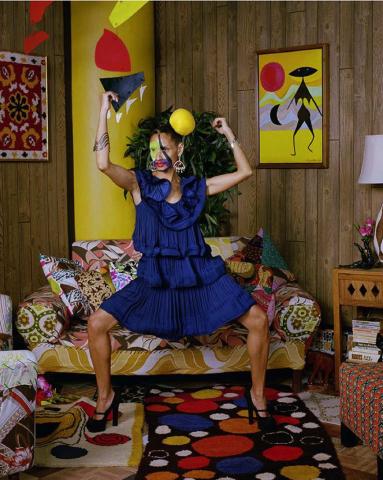 MICKALENE THOMAS Calder Series #2 -Color photograph 110,5 x 90 x 6 cm © Mickalene Thomas.Courtesy of the artist and Galerie Nathalie Obadia.
GRAND PALAIS PARIS ( November 8 – 11, 2018 )
This year, the photographic offer at the Fair is both rich and diverse with 167 galleries and 31 international publishers in the nave, 14 series, large format and installation projects showcased in PRISMES on the upper floor, the Film sector at mk2 Grand Palais, and Curiosa, a new curated sector that will present an in-depth look at a specific topic or theme in photography. This year, Curiosa will question relations to the body and eroticism.
In addition to the galleries and publishers, we invite you to discover this year an eclectic artistic program, featuring the mischievous and poetic private collection of Californian Nion McEvoy, the JPMorgan Chase Art Collection, encompassing 150 years of photographic history, the exhibition of Baptiste Rabichon, laureate of the BMW Residency, as well as the exhibitions of our partners. Don’t miss the Paris Photo - Aperture Foundation PhotoBook Awards, the Platform conversations and Artist Talks bringing together renowned figures in the field, numerous artist signature sessions, the laureates of the 2018 Carte Blanche Students, and Elles X Paris Photo, an initiative of the French Ministry of Culture and Paris Photo honoring women artists through a parcours highlighting selected artworks at the fair and in institutions throughout Paris.