
 The End (2009) © Ragnar Kjartansson
RAGNAR KJARTANSSON - Paisajes emocionales
Museo Nacional Thyssen-Bornemisza ( Madrid ) ( February 22 - June 26, 2022 )
The Museo Thyssen-Bornemisza and Thyssen-Bornemisza Art Contemporary are presenting Emotional Landscapes, an exhibition by the Icelandic artist Ragnar Kjartansson (born Reykjavik, 1976) which for the first time brings together four of his most internationally renowned video installations, The Visitors (2012), The Man (2010), The End (2009) and God (2007), in addition to a series of watercolours. The exhibition conveys Kjartansson’s fascination with America, its landscapes and music through works set on a farm by the Hudson River and in the Rocky Mountains, accompanied by blues and jazz. It makes use of the museum’s new installation entitled American Art from the Thyssen Collection to establish dialogues with 19th and 20th century paintings.
 David Nash, Red Tree, 2021. Photo © Jonty Wilde
Bothy Gallery, Yorkshire Sculpture Park and The Weston Gallery ( Wakefield United Kingdom ) ( 19 February – 5 June 2022 )
David Nash has dedicated his artistic life to an evolving study of trees and wood, absorbing knowledge through haptic experience and close observation over decades. This new exhibition in The Weston Gallery is dedicated to the artist’s drawings inspired by trees, from the observational and documentary, through to intensely coloured, abstract works that capture the essence of their life force. Nash’s long association with YSP began over forty years ago and Full Circle marks an affinity between artist and organisation. In the early 1980s, he wrote in a letter regarding his forthcoming YSP residency: “environment and ecology are a first consideration for me as an artist”. This prescient and enduring occupation not only with the intersection of nature and art, but our direct human relationship with the natural environment, makes Nash’s body of work ever more pertinent as we address the climate crisis. A critical aspect of his admiration for trees, and one we might learn much from, is that “trees take just enough and give back more”.
Drawing is as central and constant in Nash’s practice as the trees it grows from. It is a way of learning about and understanding his subject, of finding form for ideas, recording and responding to forms from life. Works in The Weston Gallery, a significant number of which have never been exhibited before, will be enlivened by the natural light that floods the space and will resonate with the far-reaching landscape views.
Spanning four decades, a broad range of drawings reflects different processes and types of mark making, from fine graphite to thick, smoky charcoal, and bold swathes of colour achieved by applying pure pigment with cloth. This directness, seen across the exhibition, is a result of the fact that the artist draws immediately and rapidly from life in the landscape, driven by the particular qualities of trees and their environments. Other works reflect at greater distance, made in the studio and concentrating on embodying the sensation of a principal characteristic such as colour, as so vibrantly demonstrated in Red Tree (2021).
 VvsH6 (2006) , © Jordi Cano
ACVIC Centre d’Arts Contemporànies ( Vic ) ( 04.02 – 23.04.2022 )
The project "Jordi Cano Universe" has been structured according to various subject-areas, the first of which attempts to construct an intellectual portrait, based upon the cultural references that accompanied him throughout his life, references that were repeated insistently until they became almost obsessive. An obstinate attitude, always faithful to those authors and artists to whom, as soon as he had discovered them, he devoted himself to absorbing more of their works, and from whom he could never distance himself. A cultural universe consumed with delight, which led him to "think with his feet, hands, eyes and head", an applied ideology, perhaps unconsciously at first, but which eventually became a pedagogical tool of the first order.
 Effondrement of Arcs, Corten Steel 2019 : Lieu d'Art et Action Contemporaine (LAAC), Dunkirk, France, Photo: Vincent Bijan, LAAC Dunkirk © Bernar Venet and VG Bild-Kunst, Bonn 2022
BERNARD VENET. 1961 – 2021 60 YEARS OF PERFORMANCE, PICTURES AND SCULPTURES
Tempelhof Airport Hangar 2 and 3, Berlin (January 29 – May 30, 2022)
More than 150 works by internationally renowned French sculptor Bernar Venet show all facets of his work over the past 60 years. The 8,000 m2 exhibition in Hangars 2 and 3 at Tempelhof Airport will be open to visitors from January 29. Bernard Venet, 1961-2021. 60 Years of Performance, Painting and Sculpture is the largest and most extensive retrospective of the french artist worldwide to date. It encompasses all of his complex and extensive oeuvre as a sculptor, painter, performance artist, and radical conceptual artist. The exhibition brings together more than 150 works that reflect the artist's uncompromising and almost obsessive approach to constantly reshaping his environment through art. The retrospective is the first in a series of exhibitions to be shown over the next two years in the spectacular 8,000m2 Hangars 2 and 3 of the former Berlin Tempelhof Airport.
From the beginning in his first studio, the exhibition traces the trajectory of Bernar Venet and the creation of a work that continues to this day questioning itself. The most exposed French sculptor to date has always reaffirmed his vision of art, which goes far beyond the formal and spatial. His effort is still firmly rooted in the overwhelming desire not to simply accept the world as it is, but to give it his own perspective. Unflinchingly direct and convinced of the emotionality and intention of symbiotically combining his existence with his creative quest, Venet once again reflects his ultimately profoundly optimistic aspiration not to reinvent the world, but to change the viewer perception. The exhibition is organized by the Bonn Foundation for Art and Culture. The curator is Walter Smerling.
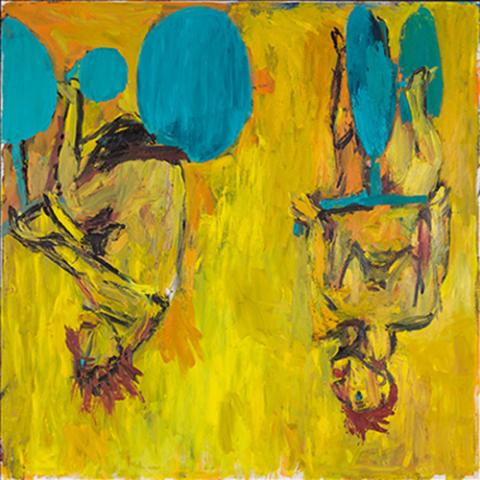 Georg Baselitz, « Die Mädchen von Olmo II », 1981 © Georg Baselitz Photo © Bertrand Prévost - Centre Pompidou, Mnam-Cci / Dist. RMN-GP
Centre Pompidou - Paris ( 20 Oct 2021 - 7 Mar 2022 )
"Baselitz – The retrospective" is the first exhaustive exhibition of the German artist in the Centre Pompidou. It brings together his masterpieces of the last six decades in chronological order, revealing his most striking creative periods: from the first paintings and the Pandemonium manifesto in the early 1960s to the Heroes series; from the Fractured compositions and the inverted motifs of 1969, including the successive groups of works for which the artist experimented in masterly fashion with new pictorial techniques featuring varied aesthetics, sustained by references to the history of art and his intimate knowledge of the work of many artists, such as Edvard Munch, Otto Dix and Willem de Kooning, through to the “Russian Paintings” and the self-reflexive creations entitled "Remix" and "Time".
An unclassifiable artist, wavering between figuration, abstraction and a conceptual approach, Georg Baselitz claims to paint images that have not yet existed and to exhume what was rejected in the past: "I was born in the midst of a destroyed order, a landscape in ruins, a people in ruins, a society in ruins. And I didn't want to introduce a new order. I had seen more than enough of so-called orders. I was forced to call everything into question. I had to be ‘naïve’ all over again, begin again. I have neither the sensitivity nor the education or philosophy of the Italian mannerists. But I am a mannerist in the sense that I deform things. I am brutal, naive and Gothic."
Georg Baselitz's powerful work is inextricably linked to the artist's imagination and experience, revealing his constantly renewed questions about opportunities to portray his memories, variations on traditional painting techniques and motifs, aesthetic forms established in the course of the history of art, and the formalisms dictated and communicated by the different political and aesthetic regimes of the 20th and 21st centuries, thus illustrating the complexity of being a painter and an artist in post-war Germany.
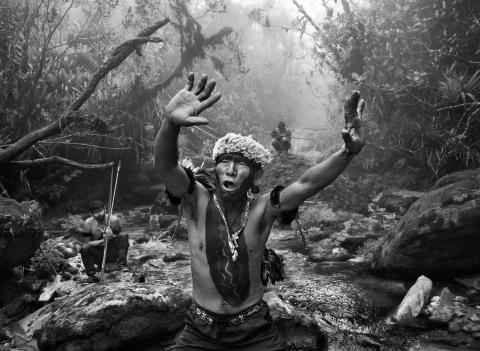 Sebastião SALGADO/nbpictures
Science Museum, Exhibition Road, South Kensington, London (13 October 2021 – 20 March 2022)
‘What I want is to create a discussion about what is happening around the world and to provoke some debate with these pictures,’ Sebastião Salgado once said, having founded Instituto Terra, a non-profit organisation that has turned 17,000 acres of Amazon rainforest into a nature reserve and focuses on reforestation, conservation and environmental education. Returning to London for the first time since 2013, the photojournalist's 200 black and white prints at the Science Museum demonstrate both the delicacy and urgency of the Amazon’s existence. From the communities most affected by the climate crisis to the indigenous leaders whose voices Salgado aims to amplify, it’s a moving, provocative and challenging collection that was seven years in the making and involved working closely with 12 different communities.
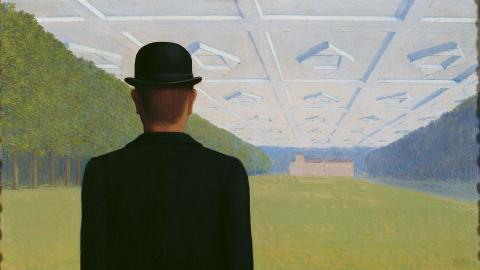 René Magritte. 'El gran siglo', 1954. Óleo sobre lienzo, 50 x 60 cm. Kunstmuseum Gelsenkirchen, lb 65/27. © René Magritte, VEGAP, Madrid, 2021
RENÉ MAGRITTE - The Magritte machine
Museo Nacional Thyssen-Bornemisza ( Madrid ) ( September 14, 2021 - January 30, 2022 )
The exhibition The Magritte machine is the first retrospective devoted to René Magritte (1898-1967) to be held in Madrid since the one organised by the Fundación Juan March in 1989. The title The Magritte machine emphasises the repetitive, combinatorial element present in the work of the great Surrealist painter, whose obsessive themes constantly reappear with innumerable variations.
Curated by Guillermo Solana, artistic director of the Museum, the exhibition brings together more than ninety paintings and an installation in the Sala Balcón Mirador of a selection of photographs and domestic films made by the painter himself.
Magritte's work has introduced highly original approaches and images of great beauty to the art of our time. His pictorial work, in which established rational structures are called into question and accepted temporal, spatial and linguistic values are questioned in favor of other possible ways of understanding the world, reflect many of the concerns of the movement led by André Breton. .
But more than following common interests of surrealism, such as the dream itself or deep psychology, Magritte investigated alternative ways of facing reality based on a fundamental idea: the way things "are" is nothing more than an accepted rational structure collectively. Freedom develops when these parameters of knowledge are called into question and new ones are opened.
The exhibition is divided into seven sections: The powers of the magician, Images and words, Figure and background, The painting and the window, The face and the mask, Mimicry and Megalomania.
 Grand Palais Éphémère - © Wilmotte & Associés Architectes
Grand Palais Éphémère ( 9 to 12 September 2021 )
Art Paris will be the very first arts event to be held at the Grand Palais Éphémère on the Champ-de-Mars, a spectacular structure fit for the 21st century designed by Jean-Michel Wilmotte.
This 23rd edition with some 140 modern and contemporary art galleries from 23 countries (and the noteworthy arrival of several leading galleries) will showcase an outstanding selection of works. Both a regional and cosmopolitan fair, Art Paris plays host to large, prestigious galleries alongside small independents mainly from Europe, but also from such far-flung locations as South Korea, Colombia, the Ivory Coast, Guatemala and Uruguay.
The main theme of the 2021 edition is the return to painting. In Portraiture and Figuration, A Focus on the French Scene, independent exhibition curator Hervé Mikaeloff presents his perspective on the revival of figurative painting in France with a selection of 20 artists from amongst the exhibiting galleries.
Art Paris also encourages the presentation of monographic exhibitions - twenty-six this year - whilst supporting young galleries and emerging artists in the “Promises” section, which provides a forward-looking perspective with cutting-edge contemporary galleries from Abidjan, Guatemala City, Marseille, and Paris.
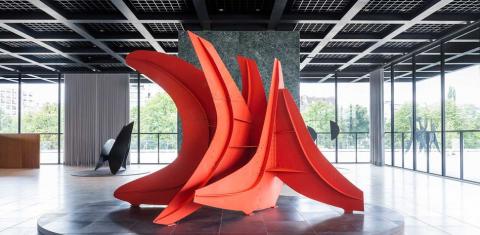 Alexander Calder, Five Swords, 1976, Sheet metal, bolts, paint, 541 x 671 x 884 cm / 213 x 264 x 348, Calder Foundation, New York © 2021 Calder Foundation, New York / Artists Rights Society (ARS), New York. VG-Bildkunst Bonn, 2021 / Photo: David von Becke
ALEXANDER CALDER . Minimal / Maximal
Neue Nationalgaleri Berlin. ( 22.08.2021 to 13.02.2022 )
Alexander Calder (1898–1976) has been closely associated with the Neue Nationalgalerie for decades, thanks to his masterpiece Têtes et Queue (1965). The outdoor sculpture was installed for the inauguration of Mies van der Rohe’s iconic work of architecture and is now returning to the museum terrace for its reopening.
The American modernist’s transformative mobiles, stabiles and standing mobiles range from the miniature to the monumental. This exhibition traces the unique relationship between size, scale and spatiality in Calder’s works, while juxtaposing his organic forms with the strict geometry of Mies van der Rohe’s building in a poetic dialogue.
The open, experimental approach of the installation – which was specifically conceived for the Neue Nationalgalerie’s glass hall – relies on the participation of visitors, who will be able to experience some of Calder’s works in motion. Some of Calder’s works are activated at varying times, up to four times daily.
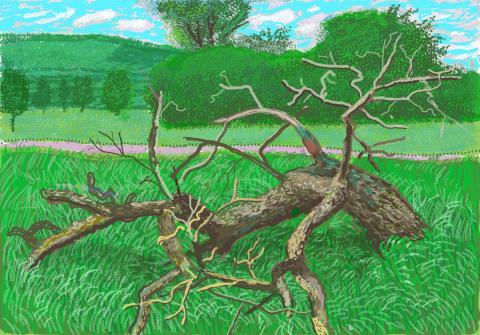 David Hockney, No. 323, 13th May 2020. iPad painting. © David Hockney.
DAVID HOCKNEY: The Arrival of Spring, Normandy, 2020
Royal Academy of Arts ( London ) ( May, 23 — September, 26 2021 )
David Hockney is one of the most important British artists of the 20th century – and he remains one of the most inventive.
Throughout his career, he’s investigated new technologies and explored different ways to make art, beginning with his iPhone in 2007 before adopting the iPad and Stylus in 2010.
This new body of work – 116 works in total – has been ‘painted’ on the iPad and then printed onto paper, with Hockney overseeing all aspects of production.
As Hockney himself notes, working on the iPad requires the ability to draw and paint. Each work – which has been printed far larger than the screen on which it was created – allows you to see every mark and stroke of the artist’s hand.
Made in the spring of 2020, during a period of intense activity at his home in Normandy, this exhibition charts the unfolding of spring, from beginning to end, and is a joyous celebration of the seasons.
Opening exactly a year after the works were made during the global pandemic, this exhibition will be a reminder of the constant renewal and wonder of the natural world – and the beauty of spring.
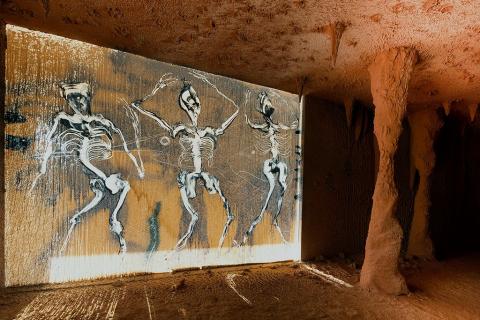 @ Miquel Barceló - @ photo Phllippe Chancel
Villa Carmignac, Porquerolles ( May 20 - October 17. 2021 )
From one island to another—from Mallorca to Porquerolles—and a Catalan studio to the Villa Carmignac, Miquel Barceló inscribes his work within a Mediterranean progression. In dialogue with The Imaginary Sea, he was given carte blanche to entirely transform the Villa’s vaulted gallery.
The deeply insular artist draws from the sea, the sand, the seascape: sources that inspire him. Ressac is a painting that one enters, made up of successive layers of plaster and clay that embrace every volume and surface of the space: walls, floors and glass partitions. Like painting projected onto architecture, it evokes the movement of an intense wave doubling backing on itself. This devastated landscape is, for Miquel Barceló, akin to the painter’s studio, transformed into a strange cave, dry after the wave recedes and the water evaporates.
Submerged by this tidal wave like a marine life Pompeii, objects, people and animals (octopuses, swordfish, bison)—be they protectors or predators—are trapped in the clay. This attack of the sea conveys a new shape, revealing traces of an ancient society on the walls like cave art, seemingly connecting this marine-inflected work to its origins.
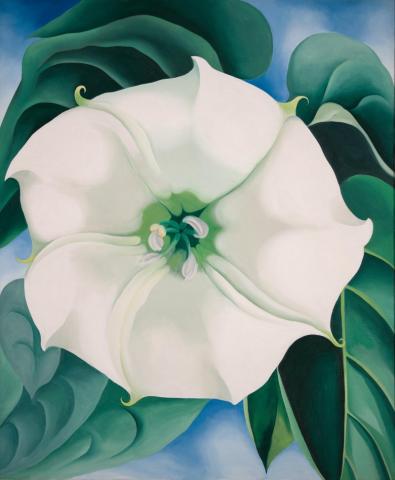 Georgia O'Keeffe Estramonio. Flor blanca n.º 1 1932 Oil on canvas 121,9 × 101,6 cm Crystal Bridges Museum of American Art, Bentonville, Arkansas, 2014.35 © Georgia O’Keeffe Museum, VEGAP, Madrid, 2021 Photography by Edward C. Robison III
Museo Nacional Thyssen-Bornemisza (Madrid) ( April 20 - August 8, 2021 )
The museum presents the first retrospective in Spain of Georgia O'Keeffe (1887-1986). Through a selection of approximately 90 works, the visitor can immerse themselves in the pictorial universe of this artist, considered one of the greatest representatives of North American art of the 20th century.
The exhibition is a complete journey through O'Keeffe's artistic career, from the works of the 1910s with which she became a pioneer of abstraction, through her famous flowers or her views of New York - thanks to the that she was exalted as one of the main figures of the modernity of her country-, even the paintings of New Mexico, the result of her fascination with the landscape and the mixture of cultures of this remote territory.
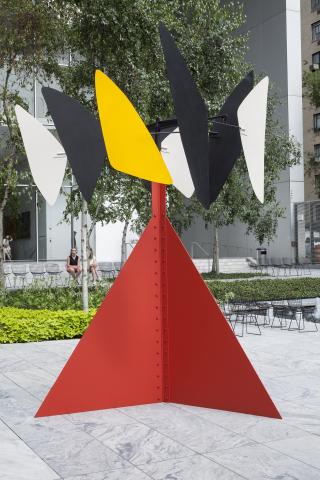 Alexander Calder. Sandy’s Butterfly. 1964. Painted stainless sheet steel and iron rods, 12′ 8″ x 9′ 2″ x 8′ 7″ (386 x 279 x 261 cm). The Museum of Modern Art, New York. Gift of the artist. © 2021 Calder Foundation, New York / Artists Rights Society (ARS),
ALEXANDER CALDER : Modern from the Start
The Museum of Modern Art ( New York ) ( March 14, – August 07, 2021 )
Alexander Calder reimagined sculpture as an experiment in space and motion, upending centuries-old notions that sculpture should be static, grounded, and dense by making artworks that often move freely and interact with their surroundings. “One of Calder’s objects is like the sea,” wrote the philosopher Jean-Paul Sartre, “always beginning over again, always new.” Bringing together early wire and wood figures, works on paper, jewelry, mobiles in motion, and monumental abstract sculptures, the exhibition takes a deep dive into the full breadth of Calder’s career and inventiveness.
Calder’s ever-changing artworks invite a viewer’s sustained attention; and The Museum of Modern Art has provided a setting for this productive exchange ever since his work was first exhibited here in 1930, just months after the Museum opened its doors. This exhibition looks at Calder’s work through the lens of this connection. Throughout MoMA’s formative years, Calder, in his unofficial role as “house artist,” was called upon to produce several commissioned works—including Lobster Trap and Fish Tail, a multicolored mobile that hangs in the same stairwell for which it was made in 1939. His works have been a mainstay of the Museum’s galleries and Sculpture Garden ever since.
Drawn from MoMA’s collection and augmented with key loans from the Calder Foundation, the exhibition celebrates one of the most beloved artists of the 20th century and presents rarely seen works, including the large-scale Man-Eater with Pennants, which will be on view in the Sculpture Garden for the first time in more than 50 years after new conservation.
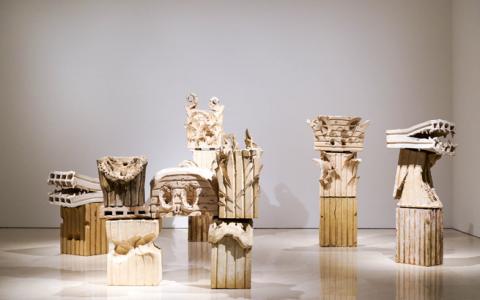 Miquel Barceló's Totems in the Museo Picasso Málaga exhibition. © Miquel Barceló, VEGAP, Málaga, 2021
MIQUEL BARCELÓ . Metamorphosis
Museo Picasso Málaga ( January 27 - September 26 . 2021 )
The Museo Picasso Málaga presents the exhibition Miquel Barceló. Metamorphosis, which takes its name from the famous story by Franz Kafka published in 1915, with about a hundred works made between 2014 and 2020 that can be seen from January 27, 2021. After more than a decade of absence in Malaga, the artist meets in an exclusive selection of works made in recent years: thirty ceramics, thirteen paintings, forty-two watercolors, six travel notebooks and a small sculpture; as well as an installation made up of seven large bronzes that has been installed in the central courtyard of the museum.
Mutation, mobility and transition are some of the characteristics of the Mallorcan artist's work, whose creative world has undergone a permanent metamorphosis from the beginning of his career. The passage of time and the alchemy of the materials stand out as elements of the common thread of this exhibition that has the collaboration of the “la Caixa” Foundation.
The exhibition Miquel Barceló. Metamorphosis, curated by Enrique Juncosa, pays attention to the transhumant cultural condition of the artist, at the same time that it supposes a critical approach to creation understood as a project of unlimited progress: each of his works leads us to another, in a process of cyclical reinvention. Starting from the reality that he sees, lives, reads and imagines, the representations include sociological or ecological nuances, at the same time that they express a passionate inner life. His work has been exhibited in prestigious institutions around the world such as the Prado Museum, Madrid; the Musée du Louvre, Paris; or the Galleria Nazionale d’Arte Moderna, Rome, among others.
As for Pablo Picasso, also for Barceló ceramics, painting or drawing are variations, experiments of a whole: “Each work is experimental, each work is an essay for another, which will probably never exist, and I think that it is as valid for my painting as it is for my ceramics or for anything that comes out of my hand ”. He affirms the Mallorcan that what he has received from Picasso is "a kind of generic influence, a way of relating to life, a way of being in the world." The constant resumption of the search, the versatility in the exploration of new media, the interrelation between various artistic techniques and periods, an incessant and dizzying way of working, the chromatic richness, the discourse with the great tradition, the fascination for mythology and The archaic symbolism of bullfighting or the illustrations in books, somehow unite these two Spanish artists, as cosmopolitan as children of the Mediterranean, creators of an art as primitive as it is irresistibly modern.
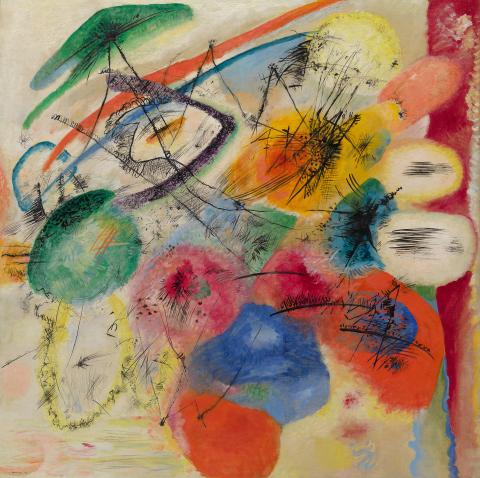 Vasily Kandinsky Líneas negras (Schwarze Linien), diciembre de 1913 Óleo sobre lienzo, 130,5 × 131,1 cm Solomon R. Guggenheim Museum, Nueva York, Colección Fundacional Solomon R. Guggenheim, por donación 37.241 © Vasily Kandinsky, VEGAP, Bilbao 2020
Museo Guggenheim Bilbao ( November, 20- 2020 - May, 23- 2021 )
As a pioneer of abstraction and a renowned aesthetic theorist, Vasily Kandinsky (b. 1866, Moscow; d. 1944, Neuilly-sur-Seine, France) is among the foremost artistic innovators of the early twentieth century. In his endeavor to free painting from its ties to the natural world, Kandinsky discovered a new subject matter based solely on the artist’s “inner necessity” that would remain his lifelong concern.
In Munich in the 1900s and early 1910s, Kandinsky began exploring the expressive possibilities of color and composition, but he was abruptly forced to leave Germany with the outbreak of World War I, in 1914. The artist eventually returned to his native Moscow, and there his pictorial vocabulary started to reflect the utopian experiments of the Russian avant-garde, who emphasized geometric shapes in an effort to establish a universal aesthetic language. Kandinsky subsequently joined the faculty of the Bauhaus, a German school of art and applied design that shared his belief in art’s ability to transform self and society. Compelled to abandon Germany again when the Bauhaus closed under Nazi pressure in 1933, he settled outside Paris, where Surrealism and the natural sciences influenced Kandinsky’s biomorphic imagery.
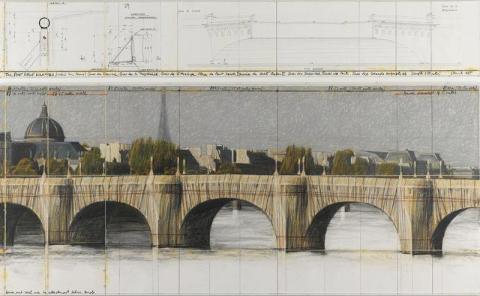 The Pont-Neuf Wrapped (Project for Paris) ©Christo et Jeanne-Claude
CHRISTO AND JEANNE-CLAUDE - Paris !
Centre Pompidou - Paris ( July 1 - October 19, 2020 )
As of 1975, Christo and Jeanne-Claude developed the idea of wrapping the Pont-Neuf in Paris in a golden sandstone-coloured polyamide canvas, which would cover the sides and the vaults of the bridge's twelve arches, the parapets, the edges and the footpaths (the public could walk on the canvas), its 44 lamps and the vertical walls of the central island of the western end of Île de la Cité and the Esplanade du Vert-Galant.
The major exhibition devoted to Christo and Jeanne Claude retraces the story of this project, from 1975 to 1985, and looks back at their Parisian period, between 1958 and 1964, before the wrapping of the Arc de Triomphe in 2021.
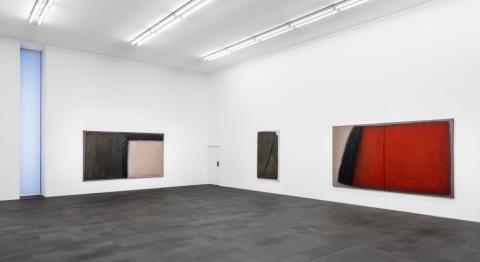 View of the exhibition @ Photo H Krause
MKM Museum Küppersmühle of Modern Art, Duisburg ( March, 11 - May, 24, 2020 )
Analogous to an architect, I construct my pictures. Man lies at the heart of my work – and he lives, just like Nature, in contrasts, tensions and disruption. We are existentially embedded within the natural interplay of ordered disorder and disordered order. My pictures constitute an attempt to translate this complex unfathomability into artistic reality. [Erwin Bechtold]
In Ewin Bechtold’s own words, contrasts have been a constant source of fascination for him, and inform every successful image. This manifests itself in the stringent reduction of his palette to black and white, and extends to the deconstruction of geometrical forms. Thus, flowing into his works are the stark contrast between the dazzling southern Mediterranean light and dark shadow, and the inherent tension between geometry and artisanship in the island of Ibiza’s cubic architecture. Work titles such as Discordia describe the system in which Bechtold operates: Order is only there to be disrupted.
The outcome is an oeuvre which commands an enduring fascination by virtue of its artistic rigour, its spatial presence and the vying tension between emotionality and rationality.
A participant of the 1968 documenta, his paintings and graphic works are represented in many important collections and museums around the world, including Fundació Juan Miro (Barcelona), Museo Nacional Reina Sofía (Madrid), the Federal Collection of Contemporary Art, (Bonn), Ludwig Museum (Cologne), Von der Heydt-Museum (Wuppertal), Tate Gallery (London), Carnegie Museum of Art (Pittsburgh/USA) or The Graphic Art Collection of the ALBERTINA Museum (Vienna). A number of his works are also contained in the Ströher Collection (Duisburg/Darmstadt).
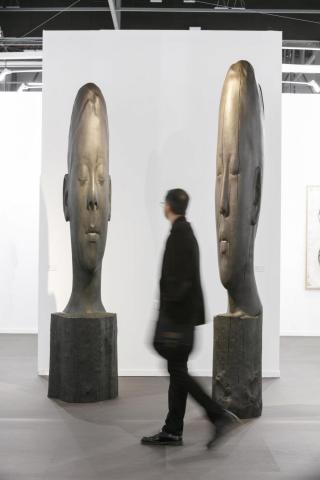 Exhibition view @ARCOmadrid 2020
Ifema Feria de Madrid ( February 26 - March 01, 2020 )
ARCOmadrid is the International Contemporary Art Fair of Madrid. One of the main contemporary art fairs of the international circuit that is held annually in February in the Spanish capital.
ARCOmadrid 2020 again presents a careful selection of national and international galleries, both in the General Program and in the Dialogues sections, curated by Agustín Pérez-Rubio and Lucia Sanromán; Opening, curated by Tiago de Abreu Pinto and Övül ö. Durmusoglu and It’s Just a Matter of Time curated by Alejandro Cesarco, Mason Leaver-Yap and Manuel Segade in the discursive program.
Along with the contents of the galleries, ARCOmadrid presents other spaces that broaden the vision of visitors around contemporary art.
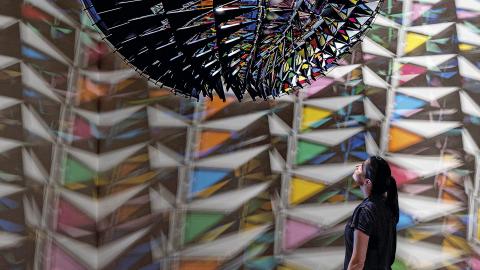 Exhibition View © FMGB Guggenheim Bilbao Museoa, 2020
OLAFUR ELIASSON - In Real Life
Museo Guggenheim Bilbao ( February 14 - June 21, 2020 )
Danish-Icelandic artist Olafur Eliasson (b. 1967) puts the experience of viewers at the center of his art. Olafur Eliasson: In real life brings to our attention some of today’s most urgent issues through around 30 artworks created by the artista between 1990 and today: sculptures, photographs, paintings, and installations that play with reflections and shifting colors and challenge the way we navigate and perceive our environment. Through materials such as moss, water, glacial ice, fog, light, or reflective metals, Eliasson encourages viewers to reflect upon their understanding and perception of the physical world that surrounds them.
Eliasson’s art grows from an interest in perception, movement, embodied experience, and feelings of self. Central to his artistic practice are his concern with nature, inspired by time spent in Iceland; his research into geometry; and his ongoing investigations into how we perceive, feel about, and shape the world around us. Studio Olafur Eliasson, his Berlin-based studio, is a space for work, but also for encounters and dialogues, that brings together a diverse team of skilled craftsmen, architects, archivists, researchers, administrators, cooks, programmers, art historians, and specialized technicians.
His practice extends beyond making artworks, exhibitions, and public interventions to include architectural projects. Convinced that art can have a strong impact on the world outside the museum, Eliasson has created solar lamps for off-grid communities, conceived artistic workshops for asylum seekers and refugees, created art installations to raise awareness of the climate emergency, and in September 2019, he was named Goodwill Ambassador for the UNDP. “Art,” Eliasson says, “is not the object but what the object does to the world.”
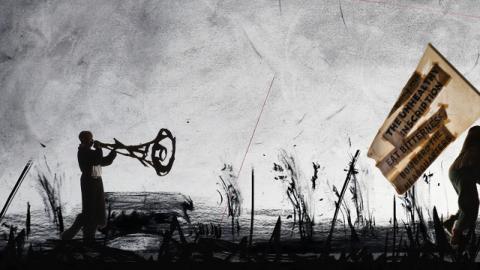 More Sweetly Play the Dance ©William Kentridge
WILLIAM KENTRIDGE - More Sweetly Play the Dance
Arsenale Amalfi (Italy) (09.02.2020 – 12.02.2020)
A show by a major figure in the contemporary art scene marks the re-opening and restoration of the atmospheric exhibition spaces of the Arsenale in Amalfi, the venue
for the ground-breaking exhibition Arte Povera più Azioni Povere held in the late 1960s.
With its avant-garde works, the event brought Italian art into the international arena with a movement that still remains a touchstone for research and creativity.
More Sweetly Play the Dance by William Kentridge is the event chosen to celebrate the memory of these places.