
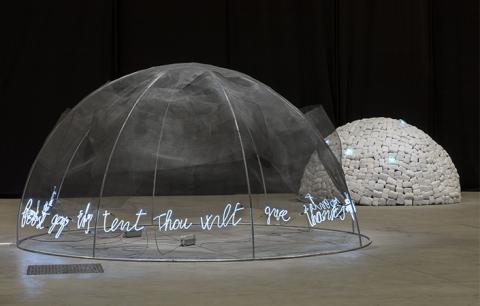
 Mario Merz, Igloos, exhibition view at Pirelli HangarBicocca, Milan , 2018. Courtesy Pirelli HangarBicocca, Milan, Photo: Renato Ghiazza © Mario Merz, by SIAE 2018
Pirelli HangarBicocca - Milan ( October 25, 2018 - February 24, 2019 )
“Igloos”, an exhibition dedicated to Mario Merz (Milan, 1925–2003)—one of the most relevant post-war artists—brings together his most iconic group of works, the igloos, dating from 1968 until the end of his life. Curated by Vicente Todolí, and realized in collaboration with Fondazione Merz, the exhibition spans the whole space of the Navate of Pirelli HangarBicocca, placing the visitor at the heart of a constellation of over 30 large-scale works in the shape of an igloo: an unprecedented landscape of great visual impact.
A key figure of Arte Povera, Mario Merz investigates and represents the processes of transformation of nature and human life: in particular the igloos, visually traceable to primordial habitations, become for the artist the archetype of inhabited places and of the world, as well as a metaphor for the various relationships between interior and exterior, between physical and conceptual space, between individuality and collectivity. These pieces are characterized by a metal structure coated in a great variety of common materials, such as clay, glass, stone, jute, and steel—often leaning or intertwined in an unstable fashion—and by the use of neon elements and wording.
The exhibition provides an overview of Mario Merz’s work, of its historical importance and great innovative reach: gathered from private collections and international museums, the igloos will be displayed together in such a large number for the first time.
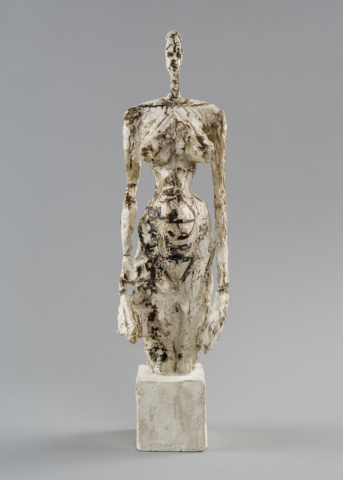 Alberto Giacometti Desnudo de pie sobre un pedestal cúbico (Nu debout sur socle cubique), 1953 Yeso pintado 43,5 x 11,7 x 11,8 cm Fondation Giacometti, París © Succession Alberto Giacometti ,VEGAP, Bilbao, 2018
ALBERTO GIACOMETTI - A Retrospective
Museo Guggenheim Bilbao ( October 19, 2018 – February 24, 2019 )
“Seeing, understanding the world, feeling it intensely and expanding our capacity for exploration to the maximum.” These were the words that Alberto Giacometti himself used to describe his drive to create throughout his career. This retrospective is devoted to one of the most influential sculptors and painters of the 20th century and will present numerous loans from the Giacometti Foundation, Paris, which possesses exceptional and diverse holdings from all stages of the Swiss artist’s life: from his Cubist and Surrealist period up until the works created in the 1940s and at the end of his life. Jean Paul Sartre called him “the perfect existentialist artist, always half way between nothingness and being." Only at the Tate Modern and in Bilbao will it be possible to see the exceptional group of Femmes de Venise, which was last show entirely at the Venice Biennial in 1956
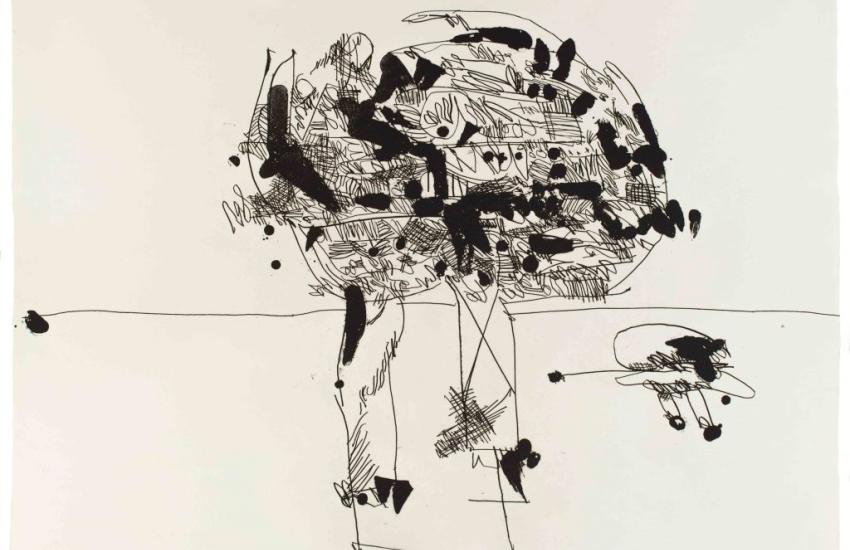 Antropofauna @Manolo Millares
MANOLO MILLARES - Descubrimientos Millares, 1959-1972
Real Academia de Bellas Artes de San Fernando ( October,11, 2018 – January 5, 2019 )
The Real Academia de Bellas Artes de San Fernando presents in Madrid Descubrimientos Millares, 1959-1972, an exhibition that includes for the first time the complete graphic work of Manolo Millares (Las Palmas de Gran Canaria, 1926 - Madrid, 1972), as well as the presentation of its catalog raisonné, work of Alfonso de la Torre, also curator of the exhibition.
The fact that the National Calcography is the first headquarters of what will be a subsequent itinerancy in the other institutions that have co-produced this project -Fundación Juan March, Fundación Museo del Grabado Español Contemporáneo and Regional Government of Castilla-La Mancha- reinforces with his prolongation in the Goya Cabinet the strong identity of the work of Millares, rooting it in the same feeling of rebellion that inspired the work of the Aragonese.
For Juan Bordes, academic delegate of the National Calcography, "the graphic work, with its vocation of diffusion, raises the cry of freedom of these two masters to transcend the redoubts of his painting. Thus, with this first site of the exhibition, the parallel between Millares and Goya becomes more evident because their revolutionary works assume the same risks, since they are born in a society with similar repressions ".
It does not seem strange the interest that Millares maintained throughout his trajectory for the engraving and the graphic techniques in general, if his childhood fascination for the Caprichos (1797-1799) and the Disasters of War (1810-1815) is remembered. , contemplated by reproductions found in 1933 in books of his family home, would exert a powerful attraction in the child and future artist.
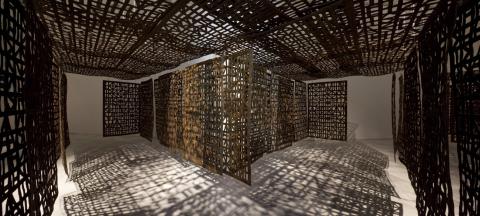 @ Cristina Iglesias
CRISTINA IGLESIAS : ENTRƎSPACIOS
Centro Botín ( Santander ) (October 6, 2018 – March 3, 2019)
Curated by Vicente Todolí, president of the Advisory Board of Plastic Arts of the Botín Foundation, CRISTINA IGLESIAS: ENTRƎSPACIOS will host a selection of twenty-three works created by the artist between 1992 and 2018, some of them of monumental format, a habitual practice in her job.
Awarded with the Spanish National Prize of Plastic Arts in 1999, Cristina's work is influenced by her stay in London in the 80s, where she found processes of sculpture materialization much more open. In addition, it was in the United Kingdom where he began to connect not only with the "new British sculpture", but also with the Düsseldorf school. In this period of discovery, he becomes familiar with the work of Eva Hesse and Robert Smithson, among other artists whom he considers important in that formative period, although his work is totally isolated from any current or trend.
Throughout his career, Iglesias has defined a unique sculptural vocabulary, creating immersive and experiential environments that reference and unite the architecture, literature and specific cultural influences of the place. Through a language of natural forms and built in various materials, poetically redefines the space by confusing interior and exterior, organic and artificial, combining industrial materials with natural elements to produce new sensorial spaces unexpected for the viewer.
Considered one of the most internationally recognized Spanish artists, in the exhibition CRISTINA IGLESIAS: ENTRƎSPACIOS a large selection of pieces will be presented, which will occupy the second floor of the west volume of the Botín Center in full and which will coexist in total harmony with her work in the Gardens from Pereda “Desde lo subterráneo”.
The last major exhibition of Cristina Iglesias in Spain took place at the Reina Sofía National Art Center Museum in 2013, so this show is a unique opportunity to enjoy her career and her most recent work.
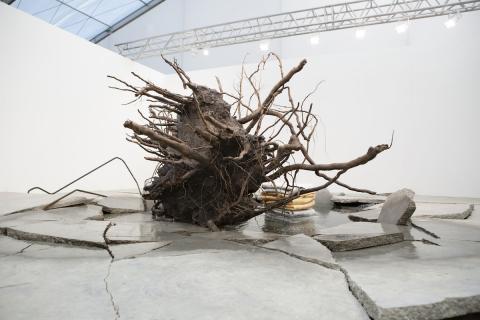 Installation view of Tatiana Trouvé, The Shaman, 2018, at kamel mennour’s booth at Frieze London, 2018. © ADAGP Tatiana Trouvé. Courtesy the artist and kamel mennour, Paris/London.
Regent’s Park ( 4 – 7 October 2018 )
Frieze London 2018 will showcase the best of international contemporary art, with a discerning selection of around 160 galleries presenting their most forward-thinking artists and imaginative presentations. Opening for the first time with a two-day Preview, Frieze London coincides with Frieze Sculpture and Frieze Masters in The Regent’s Park, together forming the most significant week in London’s cultural calendar. Global lead partner Deutsche Bank supports Frieze London for the 15th consecutive year, continuing a shared commitment to discovery and artistic excellence.
New collaborations with international curators, institutions and galleries will respond to contemporary issues – from the lack of visibility of women in the marketplace to hidden systems of communication and control – and create an exceptional environment for creativity and discovery.
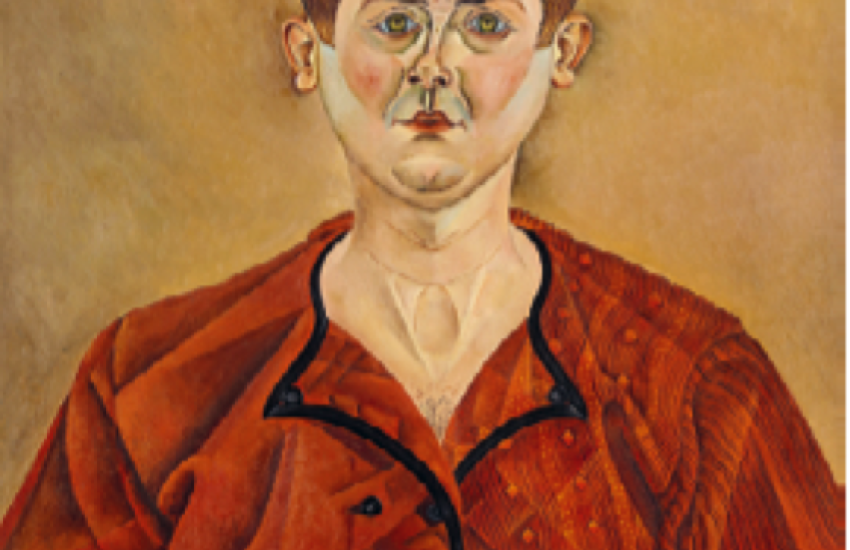 Joan Miró, Self Portrait (detail), 1919, on canvas, 73 x 60 cm, France, Paris, Musée national Picasso-Paris, Gift Picasso Heritage 1973/1978 © Successió Miró / Adagp, Paris 2018 / Photo Rmn-Grand Palais (musée national Picasso-Paris) / Mathieu Rabeau expo
Grand Palais ,Galeries Nationales . Paris ( October 3, 2018 – February 4, 2019 )
This retrospective on the great Catalan master Joan Miró (1893-1983) brings together nearly 150 key pieces to give this unique and important body of work its rightful place in modernity. This exhibition takes place forty-four years after the one organised by Jean Leymarie and Jacques Dupin at the same venue in 1974. Exceptional loans from some of the most important museums in Europe, America and across the globe, as well as major private collections, place the emphasis on the pivotal periods for Miró, who once declared: “People will understand more and more that I opened the doors to another future, that runs against all falsehood, all fanaticism.” The work of this exceptional artist shaped art throughout the 20th century, radiating its power and poetry for almost seven decades with unrivalled generosity and originality.
The exhibition has been designed specifically for the Grand Palais spaces and evokes Miró’s Mediterranean world, with major works (paintings and drawings, sculptures and ceramic, illustrated books) displayed together to illuminate an artistic career defined by continuous renewal. The exhibition begins on the first floor, with the fauvist, cubist and detailist periods, followed by a surrealist period where Miró invented a poetic world that was previously unseen in the world of 20th century painting. These fruitful periods demonstrate the artist’s investigations and research, as well as his colour palette, which fuelled a vocabulary of new and unusual forms. Neither abstract nor figurative and boasting a wealth of inventions, the poetic exhibition circuit reveals the resolutely new language that Miró continued to develop. He found the sources for his art in the vitality of daily life, blossoming into a previously unknown world where the dreams of the creator have pride of place. “I need a point of departure,” explained Miró, “be it a speck of dust or a shaft of light. This shape offers me a range of ideas, with one thing leading to another. In this way, a single thread can open up a whole new world to me.”
The rise of fascism in the 1930s saw him engaged in an endless quest for freedom. The so-called “wild” paintings illustrate the strange and unprecedented power that he gave his work during these extremely tense times. In the 1940s, the appearance of the Constellations, an exceptional series of small-format works produced at Varengeville-sur-Mer, in Normandy, opened up a dialogue with unfulfilled dreams. His investigations into ceramics soon gave rise to a form of sculpture that also demonstrated his passion for reality and a sense of reverie that seemed unimaginable in this discipline.
Miró transformed the world around him with an apparent simplicity of means, whether a symbol, the tracing of a finger or water on paper, a seemingly fragile line on the canvas, a line in the ground fused with fire, or an insignificant object paired with another. He conjured a world full of poetic transformations from these surprising juxtapositions and unusual marriages, restoring enchantment to the world. “For me, a painting should be like sparks. It should dazzle you like the beauty of a woman or a poem.”
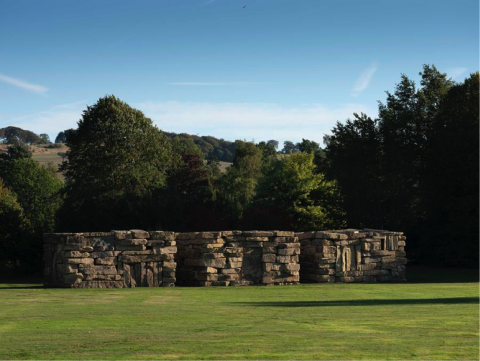 Sean Scully, Wall Dale Cubed, 2018. @ Sean Scully. Courtesy the artist and YSP. Photo @ Jonty Wilde
Yorkshire Sculpture Park - ( Wakefield - U.K.) ( September 29, 2018 – January 6, 2019)
Exploring concepts of landscape and abstraction with human experience, the exhibition unites sculpture with important recent paintings on aluminium, together with works on paper. Drawing out ideas pertinent to the singularity of YSP and its landscape, this is a poetic, robust experience that embraces the Park’s topography and Scully’s exceptional vigour, as well as his belief that in life and art there is perpetual discovery.
The exhibition presents an artist at the height of his powers. Aged 72, it is evident that there is no curtailment of Scully’s energy, drive and vision. Keenly aware of the labour that dominated the lives of his mining family, Scully’s practice is one of great rigour and toil, his output prodigious. For YSP he has made new paintings and sculpture – resolutely contemporary works that will integrate an inclination towards geometry with the romantic sincerity of landscape painting in the historical tradition.
Scully has been working in steel and stone to make powerful structures that both assert and subvert their materiality. The monumental Wall Dale Cubed (2018) in Lower Park is the latest sculpture that relates to a series of paintings that Scully began in the 1990s. This new sculpture made for YSP uses 1,000 tonnes of Yorkshire stone from a local quarry and was constructed over many weeks. Referencing ancient dry stone walls, such as those commonly found in Yorkshire, Mexico, Egypt and especially those of the Irish Aran Islands, which Scully has intensively photographed, this colossal work is built in the same way throughout, so that ‘when looking at the outside of the block, one can feel the inside without being able to see it’. In contrast, the Corten steel Crate of Air (2018) in the Country Park investigates fragmented space or ‘boxes of air’ that form their own frames to the landscape beyond. The angular shapes Scully uses in this sculpture resonate with his paintings and is made up of individual sections that form relationships once pieced together. Sited in YSP’s historic landscape, these vast metallic and stone sculptures demand a physical trek across the landscape that is extended further uphill through the former hunting ground of the Bretton Estate to Longside Gallery.
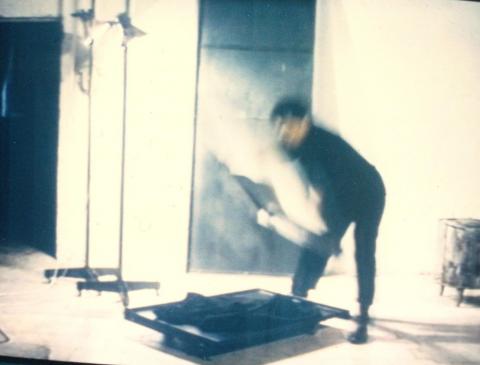 © Ángeles Marco / Performance presente instante
IVAM, Institut Valencià d'Art Modern ( September 27, 2018 - January 6, 2019 )
Ángeles Marco (Valencia, 1947–2008) is one of the most important artists in the generation of artists that spearheaded the renovation of sculpture in Spain in the 1980s and 1990s. This artist – who was associated with the theoretical assumptions of international Conceptual Art and Post-Minimalism – and her legacy have not been sufficiently studied since her death a decade ago.
As part of its policy of giving visibility to female voices that have remained on the fringe of the official historiographic discourse, the IVAM is presenting a major selective exhibition devoted to this fundamental artist, twenty years after El taller de la memoria (The Workshop of Memory), the show that this institution devoted to her in the Centre del Carme, in which a group of six monumental installations was presented.
This new exhibition devoted to Ángeles Marco presents a carefully chosen selection of sculptures and drawings and a considerable amount of archive material representative of her entire career and not previously seen, concentrating on the series of works produced in her early years – Espacios ambiguos (Ambiguous Spaces), Entre lo real y lo ilusorio (Between the Real and the Illusory), El Tránsito (The Transition) and Salto al vacío (Leap into the Void), and on the works made from 2000 to the artist’s death.
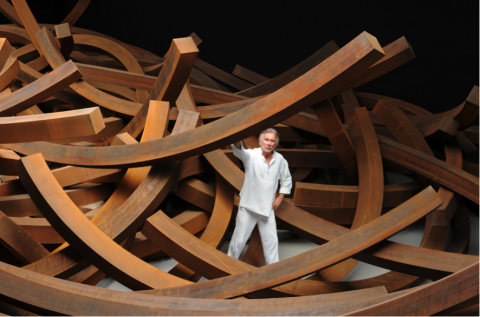 © Bernar Venet
BERNAR VENET -Rétrospective 2019 -1959
Musée d'Art Contemporain de Lyon ( September 21, 2018 – January 6, 2019 )
This exhibition presents a remarkable and previously unseen ensemble of 170 artworks, including Venet’s early performances, drawings, diagrams, and paintings, as well as the photographs, sound works, films and sculptures that retrace 60 years of creation. This is the most ambitious retrospective ever devoted to the artist.
It aims to examine the different stages that led a certain young artist, of twenty years of age, at the beginning of the 1960s to seek to ‘remove any form of expression contained in the artwork in order to reduce it to a material fact’. He then went on to appropriate astrophysics, nuclear physics and mathematical logic, and took a break of 5 years before finally returning, albeit unexpectedly, to his easel. These paintings were followed by sound works, poetry, and later by indeterminate lines, accidents, random combinations, and dispersions, culminating in the indefi nite and curved lines of the monumental sculptures in Corten steel, dedicated to the urban space.
Bernar Venet’s protean work remains little known today, partly because it is partially exhibited, in certain ‘periods’ or selected in terms of a specific medium (his works made using tar, and steel sculptures, etc.). Today, it deserves to be seen in its entirety so that the public can gain an insight into the scale, ambition, complexity, poetry and simplicity of his work.
When one retraces the artist’s career, we uncover the context in which it was born (the appearance of happenings in 1959, Nouveau Réalisme [New Realism], Fluxus and the Nice School in the 1960s, the ‘invention’ of minimal and conceptual art in the United States, where Bernar Venet settled as early as 1966), as well as the relevance and quality of its creation. This is the aim of this retrospective. The exhibition is curated by Thierry Raspail
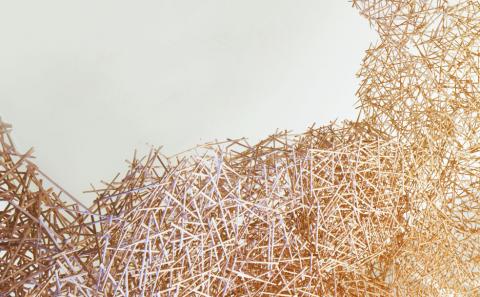 © Tadashi Kawamata
TADASHI KAWAMATA - Para-site project
The Pushkin State Museum of Fine Arts ( August, 25 - October, 28 2018 )
As part of the Pushkin Museum XXI initiative, the Pushkin State Museum of Fine Arts presents Russia’s first site-specific installation of contemporary Japanese artist Tadashi Kawamata. Kawamata creates nest-shaped installations in the permanent exposition areas and at the director’s office, using materials found during deconstruction of old buildings in the Museum quarter. These installations has been created exclusively for the Pushkin State Museum.
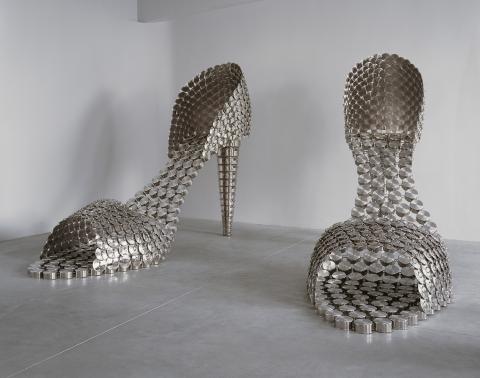 Joana Vasconcelos Marilyn (AP), 2011 © Joana Vasconcelos, VEGAP, Bilbao, 2018
JOANA VASCONCELOS - I’m your mirror
Museo Guggenheim Bilbao ( June 29 – November 11, 2018 )
One of the most notable artists of the past decade, Joana Vasconcelos works in sculpture and installation. She became internationally renowned at the 2005 Venice Biennial, where she presented The Bride (A noiva) and in 2012, she presented a selection of her creations at the Palace of Versailles, making her the first woman to present her work in the Baroque palace. Vasconcelos’ works–some of which very technically complex–move, have sound or light up, issues that the artist resolves in her studio in Lisbon with a large team of collaborators. To create them, Joana Vasconcelos uses a wide variety of materials from everyday life, such as household appliances, tiles, fabrics, artisan ceramics, bottles, medications, urinals, showers, cooking utensils, telephones, cars, or plastic cutlery. With them, she constructs stunning, playful, and direct images that make reference to sociopolitical topics related to consumer, postcolonial, and globalized societies, addressing a variety of subjects that range from immigration to gender violence. Her work always incorporates her sense of humor, also suggesting open as opposed to dogmatic meanings, and approaching, by requiring the participation of the spectator in its interpretation and viewing, the so-called relational aesthetics that emerged at the end of the 1990s. Filled with outside references ranging from Louise Bourgeois to popular culture, from metalworking to fashion, from artisan creation to the most advanced engineering, the main themes of her work cover the subject of identity, in all of its dimensions, viewed through the lens of her condition as a woman and as a Portuguese and European artist.
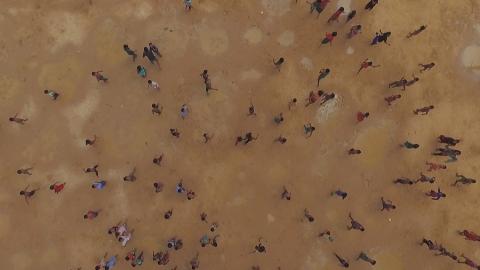 Ai Weiwei - Human Flow Film - © Ai Weiwei
Art Basel (Basel) ( June 14 – 17, 2018 )
The anchor of Art Basel’s show is its Galleries sector. Visitors will discover a breadth of Modern and contemporary works including paintings, drawings, sculpture, installations, prints, photography, video and digital art by more than 4,000 artists.
 @ Fundació Antoni Tapies
ANTONI TÀPIES - Political Biography
Fundació Antoni Tapies - Barcelona ( Juny 8, 2018 - February 24, 2019)
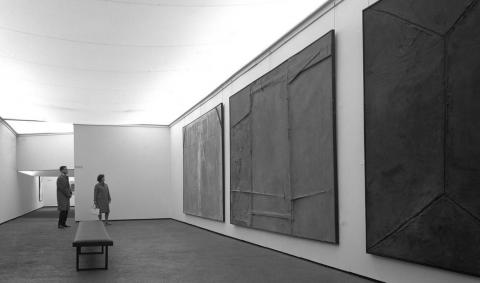
Tàpies’ work was made against a political background as diverse as the post-war era, Francoism, anti-Francoism and the establishment of democracy in Spain. Despite censorship, Tàpies’ Informalist and abstract aesthetics became the sign of a silent politicisation. During the last years of the Franco regime, his painting served as an indirect agent and demonstrated an unusual capacity for mobilisation. On an international level, Tàpies triumphed as the representative of a new generation of Spanish artists that chimed with the cosmopolitanism of Abstract Expressionism and the Art Autre promoted by Michel Tapié. His works were included in important events, such as Documenta, the Venice and São Paulo biennales, and Carnegie International. His formal exuberance, and the paradoxical and enigmatic nature of his oeuvre, made him one of the most outstanding figures in modern art.
For the first time, the exhibition will bring together groups and series of works that in the mid-1950s and 1960s established Tàpies’ identity as one of the key European artists of the post-war era, as well as works that highlight the artist’s commitment to the visualisation of the anti-Franco political struggle. In the context of this exhibition, works from the Fonds of the Fundació and loans from European collections will reveal Tàpies’ career from a biographical perspective that, far from illustrating the artist’s life, sets out to examine the life of the works in an itinerary that activates a rich and polysemic sense, and where politics is not always explicitly recognisable.
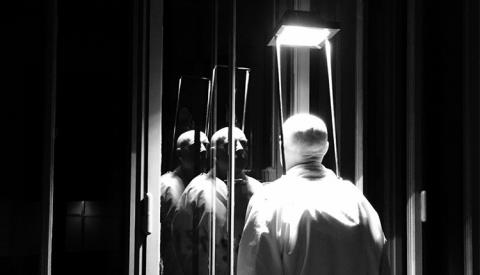 Bernardí Roig, Wittgenstein House (Viena) , 2017 - © Bernardí Roig, 2018
Es Baluard Museu d'Art Modern i Contemporani de Palma
( April 21 - September 2, 2018 )
The project, conceived as a retrospective, aims to analyse and review the complex universe of Majorcan artist Bernardí Roig (Palma, 1965) based on the presentation and decoding of his audiovisual work. The pieces will be installed in an exciting scenic arrangement, emphasising the initiatory journey between appropriation and recreation of his images and visual constructions.
These works tell us about an insatiable and nonsensical sisyphic absurd where the solitary figures of each of the videos act, caught in the repetition of gestures, in a sameness spiral. Either carrying a lamp on his back, sewing his mouth forever, spinning with a spotlight on his head without being able to get out of the claustrophobic spaces of rationalism, climbing a mountain constantly to never reach the ruins of the language philosopher’s cottage, or trapped between laughter and the aphonia of mute insults.
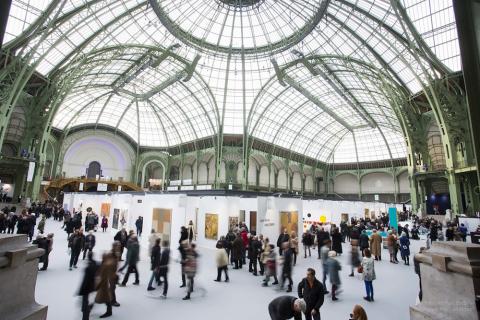 Art Paris Art Fair - Photo © Emmanuel Nguyen Ngoc
Grand Palais - Paris ( April 5th - 8th 2018 )
2018 marks the 20th anniversary of Art Paris Art Fair. Since its foundation in 1999, the fair has established itself as Paris' leading modern and contemporary spring art event. The 2018 edition will play host to 142 galleries presenting more than 990 artists from 73 countries providing an overview of European art from the post-war years to the current day, while leaving room for the new horizons of international creation from Latin America, Africa, Asia and the Middle East.
Open to all forms of artistic expression, including video art and design, Art Paris Art Fair offers a theme-based approach emphasising discovery and rediscovery. This year's guest country is Switzerland and the fair will also be taking a close look at the French art scene with a new theme developed especially for the twentieth anniversary as well as the usual monographic exhibitions in Solo Show and emerging artists in Promesses.
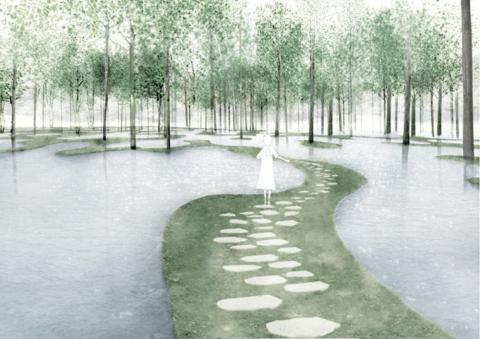 Perspective view of Art Biofarm. © junya.ishigami+associates
JUNYA ISHIGAMIi - Freeing Architecture
Fondation Cartier pour l’art contemporain ( March 30 - June 10, 2018 )
The Fondation Cartier pour l’art contemporain presents Freeing Architecture, the first major solo exhibition devoted to the work of Junya Ishigami. An important and singular figure of Japan’s young architecture scene, Ishigami, winner of the Golden Lion award at the Venice Biennale of Architecture in 2010, is the creator of a conceptual and poetic body of work in which the landscape occupies an important place.
For the exhibition Freeing Architecture, conceived specifically for the Fondation Cartier, Ishigami reveals twenty of his architectural projects in Asia and in Europe. These projects will be presented through a series of large-scale models, accompanied by films and drawings, which document their different stages of conception and construction. In dialogue with Jean Nouvel’s iconic building, this event is also the first large-scale solo-show that the Fondation Cartier pour l’art contemporain has devoted to an architect.
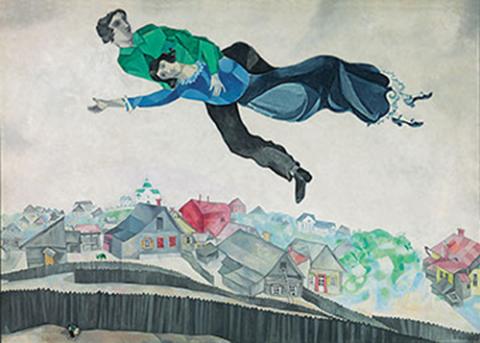 Marc Chagall "Au-dessus de la ville" 1914-1918 Galerie Nationale Tretiakov @ Adagp Paris 2017
CHAGALL, LISSITZKY, MALÉVITCH. L'avant-garde Russe a Vitebsk (1918-1922)
Centre Pompidou, Paris ( March 28 th - July 16 th, 2018 )
The exhibition devoted by the Centre Pompidou to the Russian avant-garde between 1918 and 1922 focuses on the work of three of its iconic figures: Marc Chagall, El Lissitzky and Kasimir Malevich. It also presents works by teachers and students of the Vitebsk art school founded in 1918 by Chagall: Vera Ermolayeva, Nicolai Suetin, Ilya Chachnik, Lazar Khidekel and David Yakerson.
Through 250 works and documents never seen together before, this event sheds light for the first time on the post-revolutionary years during which the history of art was written in Vitebsk, a long way from Russia's big cities.
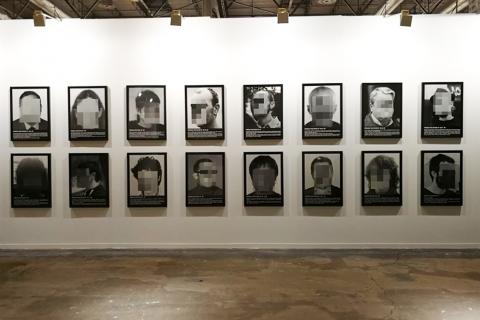 Presos políticos @Santiago Sierra
Ifema . Feria de Madrid ( February, 21 - 25 )
ARCOmadrid 2018 meeting in Halls 7 and 9 at Feria de Madrid to a total of 211 galleries from 29 countries, of which 160 are part of the General Program, joining these sections curated: “What is going to happen is not "the future", but what we are going to do” collaboration with CNP Partners and a selection of 20 galleries; Dialogues, with 14 and Opening, with 19.
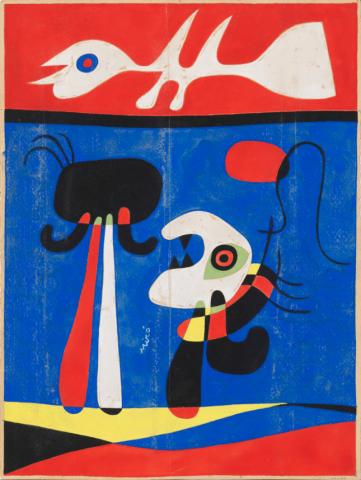 JOAN MIRÓ / Sin título (Diseño para estarcido), ca. 1946. Fundació Joan Miró. © Successió Miró 2018
JOAN MIRÓ . Order and disorder
IVAM Centre Julio Gonzalez ( February, 15 - Juny, 17 . 2018 )
Joan Miró’s work lives on and continues to question the present age. It is one of the landmarks of the early avant-gardes of the 20th century that refuses to be relegated to the mausoleum of art history, a place where creation loses all possibilities of conflict. The exhibition Joan Miró. Order and Disorder explores the traces of indiscipline left by the artist in the course of his career. From the very outset, discipline and the process of learning were a kind of captivity from which he began to free himself when he arrived in Paris.
From then on, Miró moved along a strange path in which artistic and cultural order were always questioned. His paintings became a permanent conflict that exploded between 1969 and 1973; his characters engaged in a fight between reality and representation; and his work expanded towards society with his prolific production of public art, posters understood as urban graffiti and his participation in Morí el Merma, a theatrical celebration of the death of the dictator.
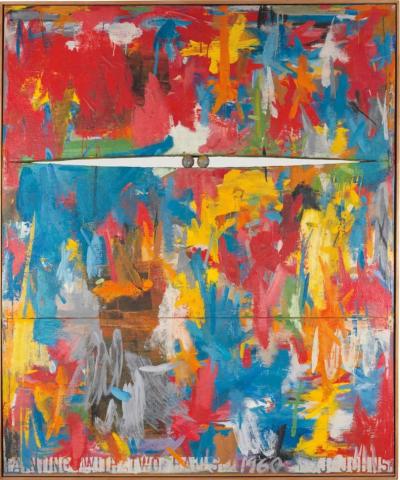 Jasper Johns, Painting with Two Balls (1960). Courtesy of photographer Jamie Stukenberg © The Wildenstein Plattner Institute, 2017. © Jasper Johns/VAGA, New York/DACS, London 2017.
JASPER JOHNS - Something Resembling Truth
The Broad Contemporary Art Museum - Los Angeles ( February 10– May 13, 2018 )
A landmark exhibition, Jasper Johns: ‘Something Resembling Truth’ features more than 120 extraordinary paintings, sculptures, prints and drawings by one of America's greatest artists. Featuring signature works from the Broad collection with loans from more than 50 international public and private collections, The Broad's presentation marks the first comprehensive survey of Jasper Johns in Southern California in more than 50 years. A collaboration with the Royal Academy in London, Jasper Johns: 'Something Resembling Truth' traces the evolution of the artist’s six-decade career through a series of thematic chapters, encompassing the full range of Johns’ materials, motifs and techniques.